Fixed Income Basics BoC: How Bonds and OIS Predict Rates
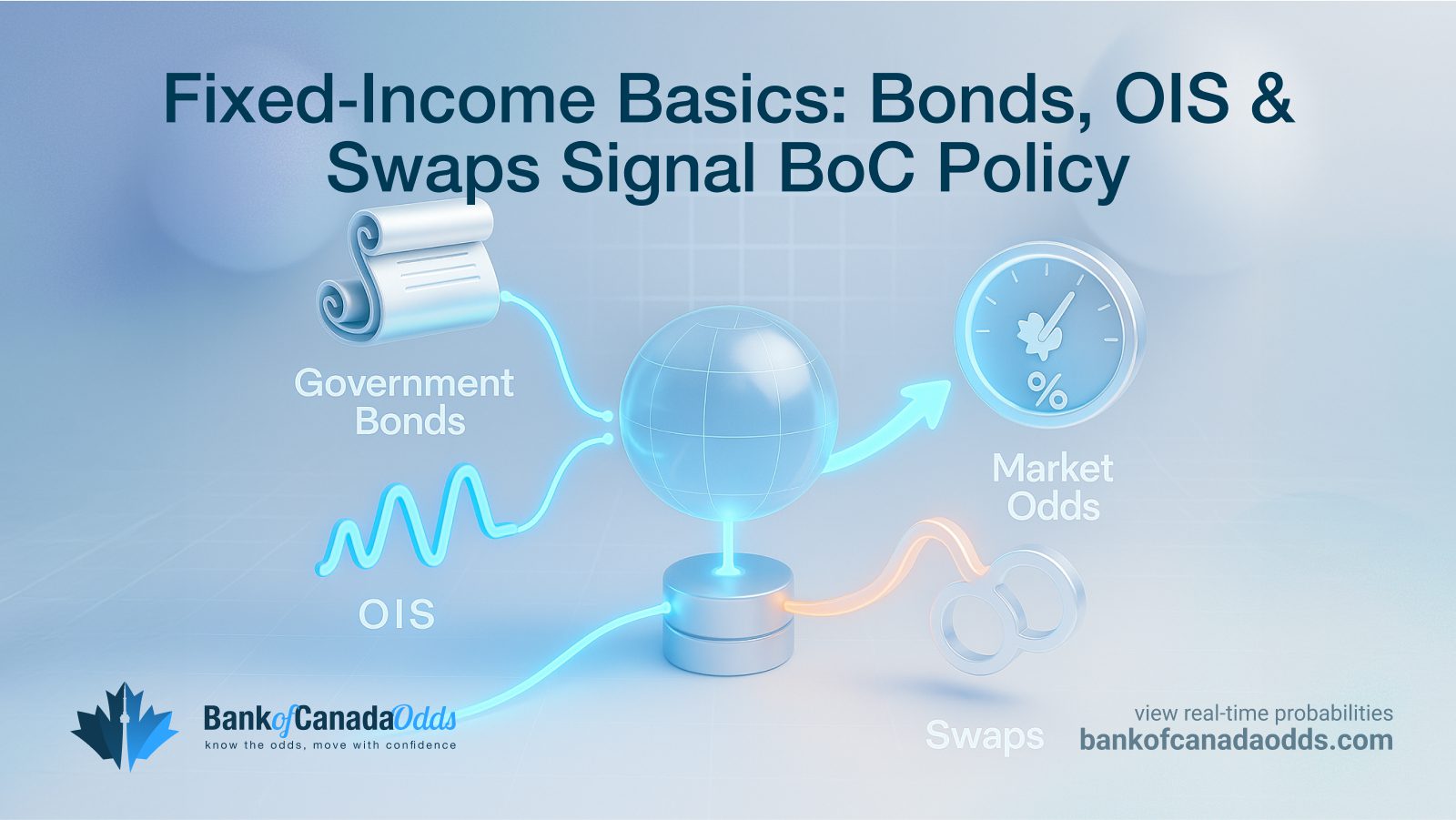
When analysts discuss the Bank of Canada’s next move, they rely on insights from fixed-income markets. These markets—through government bonds, swaps, and derivatives—offer a real-time snapshot of how investors expect interest rates to evolve. This guide breaks down the essential fixed income basics BoC watchers need to understand.
🇨🇦 Government Bonds and BoC Rate Signals
Canadian government bond yields indicate what investors demand to lend money to the federal government. For instance, rising 2-year bond yields often signal that markets expect the BoC to raise rates. These rates influence everything from mortgages to corporate borrowing costs.
📈 Overnight Index Swaps (OIS)
OIS are short-term instruments that allow investors to speculate on or hedge against central bank rate changes. If the current BoC overnight rate is 5% and a 3-month OIS is priced at 4.75%, traders are betting on a rate cut soon.
🔄 Interest Rate Swaps and Derivatives
Institutions like pension funds use interest rate swaps to manage exposure. For example, a fund might pay a fixed rate and receive a floating rate—essentially betting that central bank rates will drop. These tools go beyond simple fixed income basics but still offer BoC policy insight.
💡 Why These Market Tools Matter
- 📉 For Investors: Bond pricing often anticipates policy shifts before they’re announced.
- 🏡 For Borrowers: Fixed-rate mortgages follow bond yield trends more than central bank headlines.
- 📊 For Policymakers: The BoC uses these markets to gauge sentiment and risk pricing.
🧠 Easy Example
Imagine an OIS contract like a sports betting line—if it shifts significantly, it means the market expects a different “game outcome.” In this case, the “game” is the next interest rate decision.
🔚 Conclusion
While these concepts may seem technical at first, understanding fixed income basics BoC analysts follow gives you an edge. Whether you’re a borrower, investor, or just trying to interpret rate headlines, these tools offer powerful clues into where Canadian monetary policy may be headed.