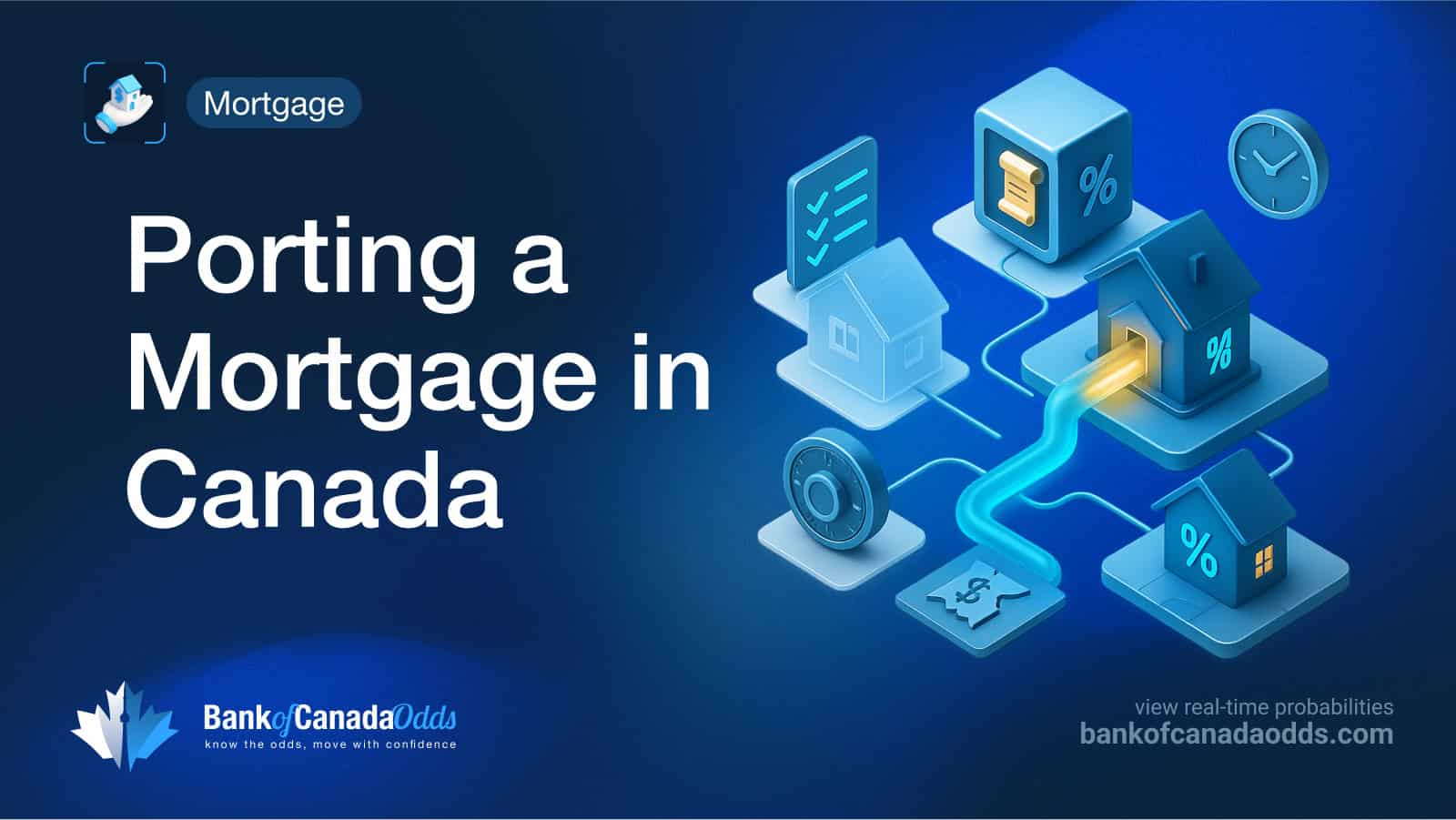
Porting a mortgage in Canada lets you transfer your current mortgage rate, balance, and term to a new property when you move. It can save you thousands by avoiding prepayment penalties and helping you keep your lower rate—especially valuable in today’s fluctuating rate environment.
What Does Porting a Mortgage Mean?
Porting means moving your existing mortgage, rate, and remaining term from one home to another. Instead of breaking your contract, you transfer it. This helps you keep your favorable interest rate and avoid costly penalties.
Example: If you have two years left on a 5‑year fixed mortgage at 4.2%, porting lets you transfer that loan to your next home without paying the higher market rate.
Market Context (October 2025)
As of October 2025, five‑year fixed mortgage rates in Canada average between 3.8% and 4.6%, while variable rates sit near 4.4%–5.0%. After the Bank of Canada’s 0.25% rate cut, more borrowers are exploring mortgage portability instead of refinancing to save on prepayment penalties.
Use resources like WOWA and Ratehub to compare current rates before deciding.
How Mortgage Porting Works
- Sell your current home: Your lender holds your existing balance temporarily.
- Buy a new home: Complete the purchase within 30–90 days to qualify for portability.
- Apply for portability: Your lender re‑evaluates your financials and the new property.
If approved, your lender transfers your balance, rate, and term to the new home. Some lenders also allow you to blend and extend if you need a higher loan amount.
Benefits of Porting a Mortgage
- Avoids prepayment penalties that can reach thousands.
- Retains your lower mortgage rate if current market rates are higher.
- Maintains continuity with your existing lender.
- Speeds up approval compared to a full refinance.
Drawbacks to Consider
- Not all mortgages are portable: Many variable‑rate products don’t qualify.
- Strict timelines: Most lenders require the sale and purchase to close within 30–120 days.
- Requalification: You must still meet the federal stress test.
- Property risk: If the new home fails appraisal, your port may be denied.
Eligibility and Requalification
Even if you’re keeping your current rate, your lender will verify updated income, credit, and property details. You’ll need to pass the mortgage stress test—qualifying at your contract rate plus 2%, or the benchmark rate, whichever is higher.
If your financial profile has changed, you may not qualify. Always confirm portability before listing your home or purchasing a new one.
Porting vs. Blending Your Mortgage
If your new home costs more, you can combine your existing rate with a new one through a blend‑and‑extend mortgage. This lets you increase your loan amount while avoiding full penalties.
Example: You have $300,000 at 4.2% and need $100,000 more at 5.0%. Your blended rate could average around 4.45%, slightly higher—but without a prepayment charge.
When Porting Makes Sense
- Your current rate is lower than today’s market rates.
- You’re mid‑term on a fixed mortgage with high IRD penalties.
- You plan to buy and sell within the lender’s 30–90‑day window.
However, if rates have dropped, breaking and refinancing could still save more overall. Compare both outcomes carefully.
Steps to Successfully Port a Mortgage
- Confirm portability: Ask your lender about eligibility and time limits.
- Get pre‑approved for your new property: Verify that your finances meet current standards.
- Coordinate closings: Align your sale and purchase dates to prevent penalties.
- Consult a broker: Brokers can calculate if refinancing saves more than porting.
- Finalize paperwork: Once both deals close, your lender transfers the mortgage.
Typical Costs and Timelines
Porting avoids major penalties but may still involve small fees:
- Appraisal: $300–$600
- Legal fees: $800–$1,200 (depending on province)
- Admin/discharge fees: Vary by lender
Processing can take a few weeks to two months, depending on lender and transaction timing.
Quick Q&A
Q: How long do I have to port my mortgage?
Most lenders give 30–90 days, sometimes longer for special cases.
Q: Can I port between provinces?
Yes, if your lender operates nationally. Some regional lenders restrict portability by province.
Q: Can variable mortgages be ported?
Some allow it, but most fixed products are easier to port—always check with your lender.
Q: Can I increase my loan amount?
Yes, typically through a blend‑and‑extend feature.
Q: Will I need to requalify?
Yes—especially if your income or debt has changed.
Final Thoughts
Porting a mortgage is one of the most practical ways to save money when moving homes in 2025. It lets you keep your current rate, avoid prepayment fees, and ensure financial continuity. However, each lender’s portability rules differ, so always confirm the conditions early.
For real‑time rate forecasts, policy updates, and mortgage strategy tools, visit BoCOdds.com—your go‑to resource for Bank of Canada insights and rate movement trends.