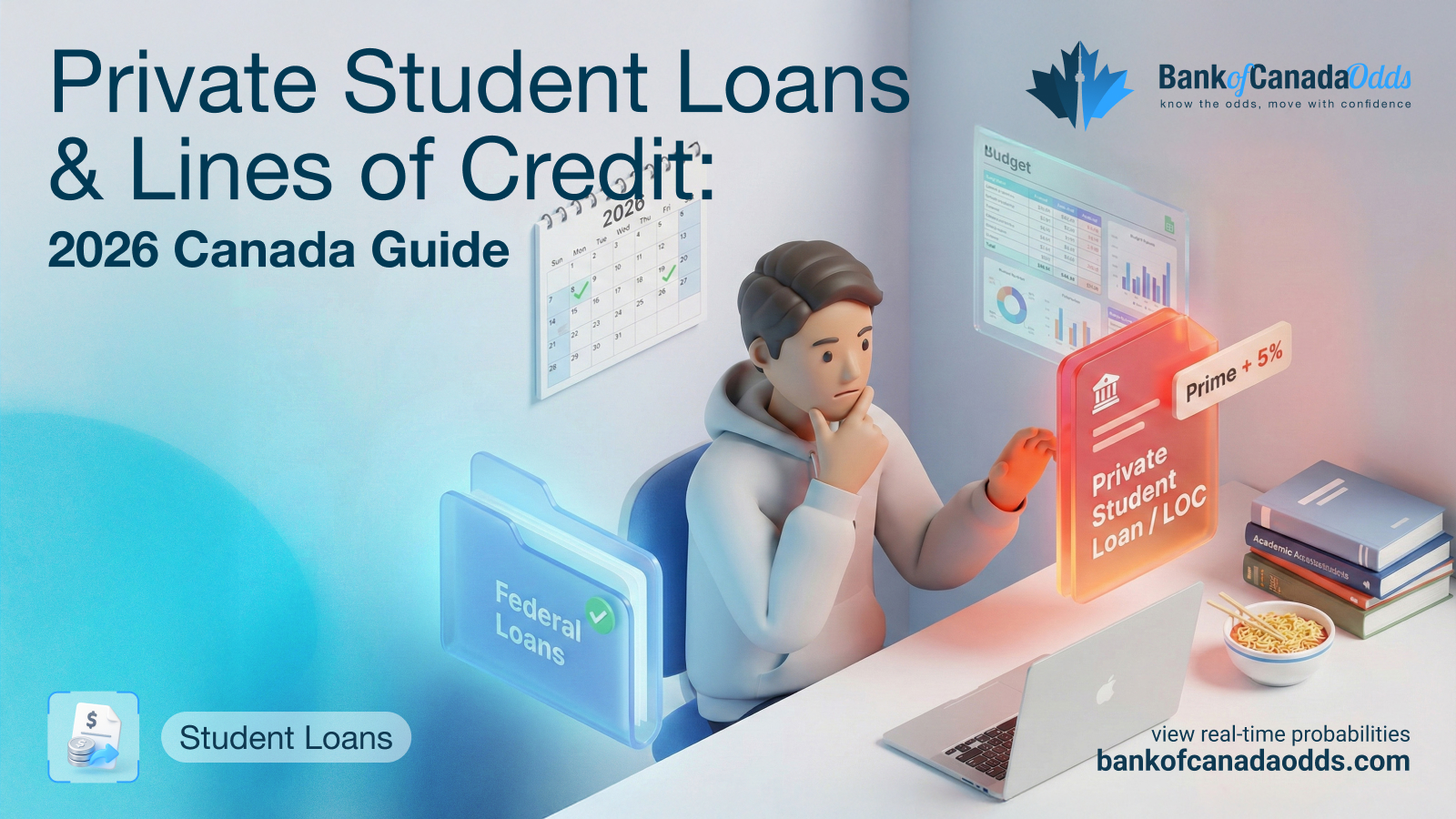
In 2026, tuition fees and living expenses in Canada continue to increase, forcing many students to rely on private student loans and student lines of credit to cover the gap left by federal and provincial funding. In exchange for this additional funding, students assume long-term financial obligations. Understanding the mechanics, risks, and repayment responsibilities of private lending is essential for minimizing long-term debt.
This guide outlines the types of private funding available to students, how they differ from government-funded programs, and how to use private financing responsibly. For broader economic context on borrowing costs, check out The Six Drivers of our economy.
Key Takeaways
- Private student loans and LOCs can help fund the gaps between your federal/provincial student loans and living/education expenses.
- Private loans generally include much higher interest rates, credit checks, and co-signer requirements.
- LOCs allow students to borrow funds and repay interest-only while in school, then convert to a traditional loan with fixed repayment schedules.
- Always exhaust federal student loan eligibility before applying for private funding.
- Research and compare all available loan and LOC options before making your decision.
What Are Private Student Loans?
Private student loans are loans provided by banks, credit unions, online lenders, and financial institutions specializing in education financing. Unlike government loans, these are strictly commercial products.
These loans can be used to pay for:
- Tuition and mandatory fees
- Rent/housing
- Food and living expenses
- Textbooks/supplies
- Professional program tuition (e.g., medicine, law, engineering)
They differ from federal loans because they require a credit check, usually require proof of income (borrower or co-signer), have significantly higher interest rates, and borrowers may be required to make interest-only payments while still in school. You can track interest rate probabilities on our Odds Dashboard.
What Are Student Lines of Credit?
A student line of credit (LOC) is a revolving form of credit similar to a credit card. Students can borrow up to a predetermined limit (typically $5,000 to $80,000 depending on the program). The Financial Consumer Agency of Canada provides detailed information on how these products work.
Key features include:
- Variable interest rates tied to the prime rate
- Interest-only payments during studies
- Borrow-as-needed flexibility
- Conversion into a traditional repayment loan after graduation (usually 12–24 months post-graduation)
Differences Between Private Student Loans and LOCs
Private Student Loans
- Loans are provided upfront as a lump sum
- Interest may be fixed or variable
- Repayment typically begins immediately after completing studies
Student Lines of Credit
- Borrow only the amount needed
- Pay interest only on the amount borrowed
- Variable interest tied to the prime rate
- Repayment begins once the grace period ends
2026 Interest Rates
Interest rates on private loans and LOCs remain high as the Bank of Canada maintains elevated rates.
Typical 2026 ranges:
- Private Loan (Fixed): 7.5%–13%
- Private Loan (Variable): Prime + 2% to +6%
- Student LOC: Prime + 1% to +5%
Professional programs may receive lower rates due to reduced default risk.
Eligibility Requirements
Students seeking private funding typically must have a strong credit rating (or a co-signer with strong credit), be enrolled in an eligible program, provide proof of income, and be a Canadian citizen or resident. Professional program students may qualify for higher borrowing limits.
Benefits of Private Student Loans
- Access to larger borrowing amounts
- Faster approval than government programs
- Useful for high-cost programs
- Some lenders offer private student loans to international students
Risks of Private Student Loans
- Higher interest rates
- No interest-free periods
- Co-signer almost always required
- Limited repayment assistance options
- Potential long-term financial strain
Benefits of Student Lines of Credit
- Borrow only what you need
- Pay interest only on borrowed amounts while in school
- Typically cheaper than credit cards
- Popular among students in professional programs
Risks of Student Lines of Credit
- Variable rates may increase
- Co-signer required
- Monthly interest payments required while studying
- Risk of over-borrowing due to flexibility
When Should Students Apply for Private Funding?
Private funding may be appropriate when federal and provincial loans do not cover expenses, you are enrolled in a high-cost program, a qualified co-signer is available, and the student fully understands long-term repayment obligations.
When Should Students Avoid Private Funding?
Avoid private funding when federal/provincial loan eligibility remains unused, income is unstable, the co-signer cannot manage repayment risk, or borrowing is for non-essential expenses.
Responsible Borrowing
- Maximize federal and provincial loans first. Visit the Government of Canada Student Aid page to check eligibility.
- Borrow the minimum required from private lenders.
- Choose fixed interest rates if prime is expected to rise.
- Avoid using credit cards for education expenses.
- Create a clear budget for tuition and interest payments.
- Make small principal payments while in school.
Common Errors Made by Students
- Borrowing the full LOC limit instead of only what is needed.
- Ignoring interest accumulation during studies.
- Consolidating multiple private student loans into a single high-interest loan.
- Using credit cards instead of LOCs or federal loans.
- Failing to compare lender terms and interest rates.
Minimizing Your Future Debt Burden
- Refinance high-interest private loans after graduation.
- Pay monthly interest to avoid capitalization.
- Convert LOC to a fixed-rate loan if interest rates rise.
- Use scholarships, bursaries, or part-time income to reduce borrowing.
FAQs
For more answers, check our Main FAQ.
Will private student loans provide better value than federal loans?
No. Federal student loans are permanently interest-free and should always be used first.
Is a co-signer required for private student loans?
Yes. Most undergraduate students and those without income require a co-signer.
Can international students get private funding in Canada?
Yes, some online lenders offer private student loans or LOCs to international students if they have an eligible Canadian co-signer.
Are LOCs less expensive than private loans?
Often yes, but LOCs have variable rates that may increase.
Can private student loans be refinanced?
Yes. Refinancing after graduation can significantly reduce interest costs.
Conclusion
Private student loans and LOCs can help students cover rising education and living costs in 2026. However, these options carry significant long-term financial risks. By understanding how private student lending works—and by borrowing responsibly—students can minimize interest costs, avoid excessive debt, and maintain stronger financial stability during their studies and beyond. Stay updated on student financing trends by joining our Subscription list.