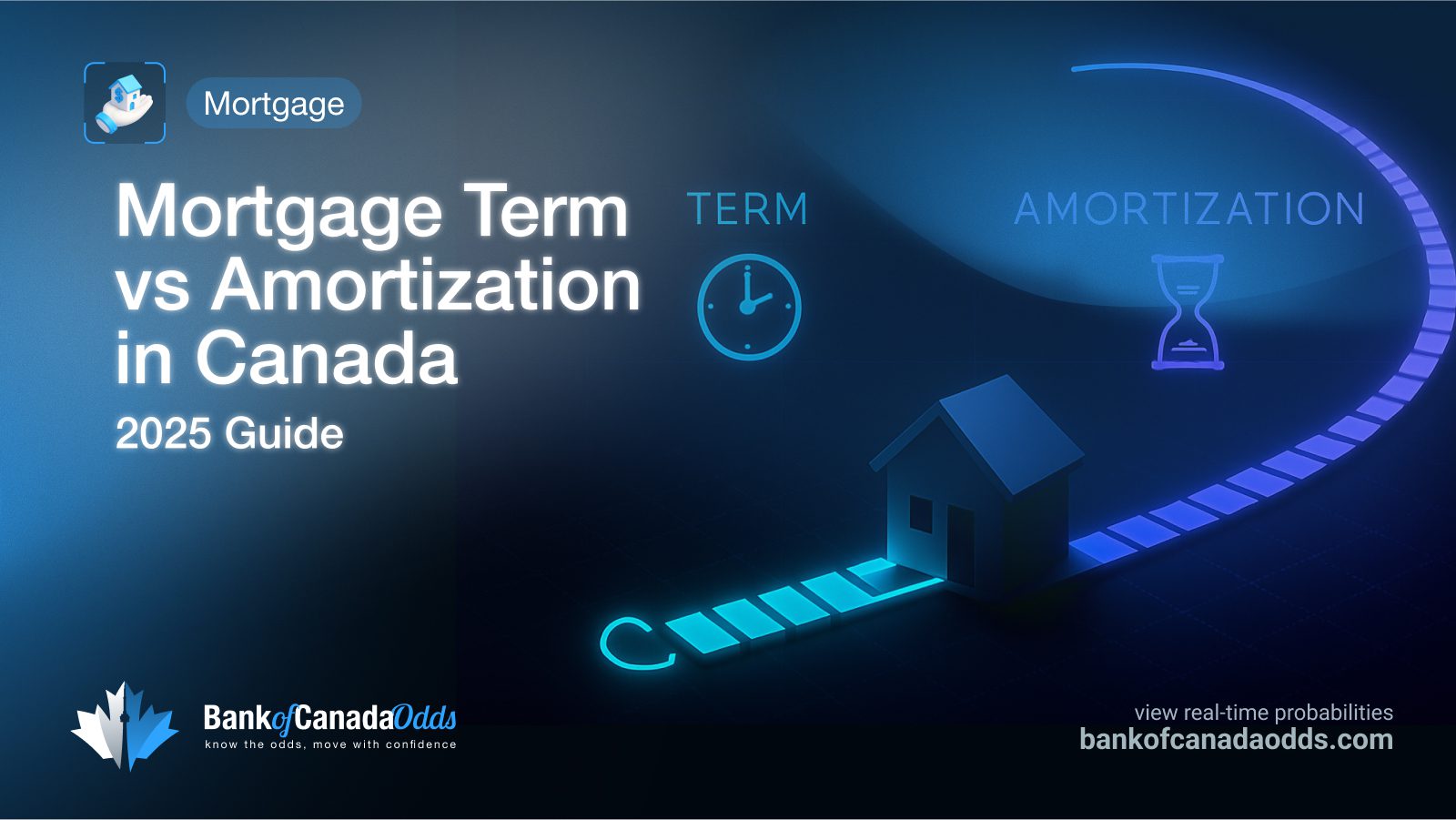
When taking out a mortgage, many Canadians confuse the mortgage term with the amortization period—but these are two very different timelines. The mortgage term is the length of your contract with a lender, while amortization is the full life of your loan. Understanding this distinction can save you thousands in interest and help align your payments with your goals.
As BankofCanadaOdds.com puts it: “Your term resets your contract; your amortization determines your full debt timeline.” In a rising or falling interest rate environment, knowing how these two work together is more important than ever.
Why It Matters in 2025 ⚡
As BoC rate cycles shift, many homeowners are reaching renewal periods with higher monthly costs. Choosing the right combination of mortgage term and amortization can reduce interest, improve cash flow, or provide flexibility in volatile markets. Strategic planning around these factors is essential to protect your budget and avoid payment shock.
Key Takeaways
- Mortgage term: the fixed contract length with your lender, typically 1 to 5 years.
- Amortization: the total repayment period, usually 25 to 30 years.
- Shorter amortizations = faster equity, less interest. Longer terms = more flexibility, but potentially higher costs.
What Is a Mortgage Term? 🔑
A mortgage term is the length of time your current agreement lasts, locking in your interest rate and conditions. At the end of the term, you can renew or refinance. Most Canadian terms range from 6 months to 5 years.
Pros:
- Locks in rate and payment structure for short- to medium-term predictability.
- Flexibility to renegotiate terms more often.
Cons:
- Short terms may require frequent renewals.
- Long terms may lock you into higher rates if the market improves.
Best for:
- Homeowners wanting periodic reassessment based on BoC changes.
- Those seeking rate stability without long-term lock-ins.
What Is Amortization? ⏳
Amortization is the total number of years it will take to pay off your mortgage, usually 25 or 30 years. A longer amortization lowers your monthly payments but increases interest paid over time.
Pros:
- Lower monthly payments make homeownership more affordable upfront.
- More control over financial flexibility for cash flow management.
Cons:
- More total interest paid over time.
- Slower equity buildup.
Best for:
- First-time buyers prioritizing affordability.
- Investors or upsizers needing lower initial payments.
Term vs Amortization: Comparison Table 📊
| Feature | Mortgage Term | Amortization |
|---|---|---|
| Typical Length | 1 to 5 years | 25 to 30 years |
| Renegotiation | Yes, at term end | No, unless refinancing |
| Payment Impact | Fixed within the term | Determines monthly size |
| Interest Cost | Shorter terms can adjust to market | Longer amortization = higher cost |
| Flexibility | Can switch lenders or rates at renewal | Harder to change mid-loan |
Historical Context in Canada 📈
- Most Canadian buyers use a 5-year fixed term with 25-year amortization.
- Since the 2020 rate cuts and 2022-2024 rate hikes, more buyers have opted for shorter terms but longer amortizations to manage payments.
- According to Government of Canada, extended amortizations beyond 25 years are only available with 20%+ down payments.
Tips for Choosing 🧠
- Match your term to expected BoC policy shifts. If cuts are coming, shorter terms may help.
- Use longer amortizations for affordability, shorter ones to save on interest.
- Reassess both at each renewal — they don’t have to stay fixed forever.
Related Guides
FAQs 🔍
- Can I change my amortization at renewal? Yes, if you’re refinancing or switching lenders, you can adjust it.
- Can I pay off my mortgage faster than my amortization? Yes, through lump sum payments or accelerated payment plans.
- Does the Bank of Canada directly affect amortization? No, but it affects your term rate, which can influence your payment strategy.
Closing Thoughts 🚦
Don’t confuse mortgage term with amortization—they impact your payments, flexibility, and interest costs in very different ways. Be strategic and evaluate both in the context of market trends, your life stage, and your risk tolerance.
BankofCanadaOdds.com: “Mortgage success comes from managing both the short game (term) and the long game (amortization).”