Paying off your mortgage early or making extra payments can reduce your total interest. But in Canada, mortgage prepayment penalties can offset those gains if you’re not strategic. Understanding how prepayments work—and when penalties apply—can help you save more and avoid surprises.
What Is a Mortgage Prepayment?
A mortgage prepayment is any amount you pay beyond your scheduled payments. It includes:
- Lump-sum payments: Extra principal payments outside your regular schedule.
- Increased regular payments: Raising monthly payments to pay off the loan faster.
- Full early payout: Paying off the entire mortgage before the term ends—usually when selling or refinancing.
Most lenders offer prepayment privileges of 10%–20% annually without penalty. Exceeding this can trigger fees.
Types of Prepayment Options
- Lump-sum: One-time payments to reduce principal.
- Payment increase: Raise your monthly payments permanently.
- Double-up: Add an extra monthly payment when possible.
- Accelerated schedule: Switch to bi-weekly or weekly payments to add an extra month per year.
Check your mortgage terms to confirm what’s allowed.
Understanding Prepayment Penalties
Lenders charge penalties if you exceed your prepayment limit or break your mortgage early. This protects their interest income.
Common Scenarios That Trigger a Penalty
- Selling your home before term ends
- Refinancing or switching lenders mid-term
- Overusing prepayment privileges
How Penalties Are Calculated
It depends on your mortgage type.
1. Fixed-Rate Mortgages
You’ll pay the greater of:
- Three months’ interest
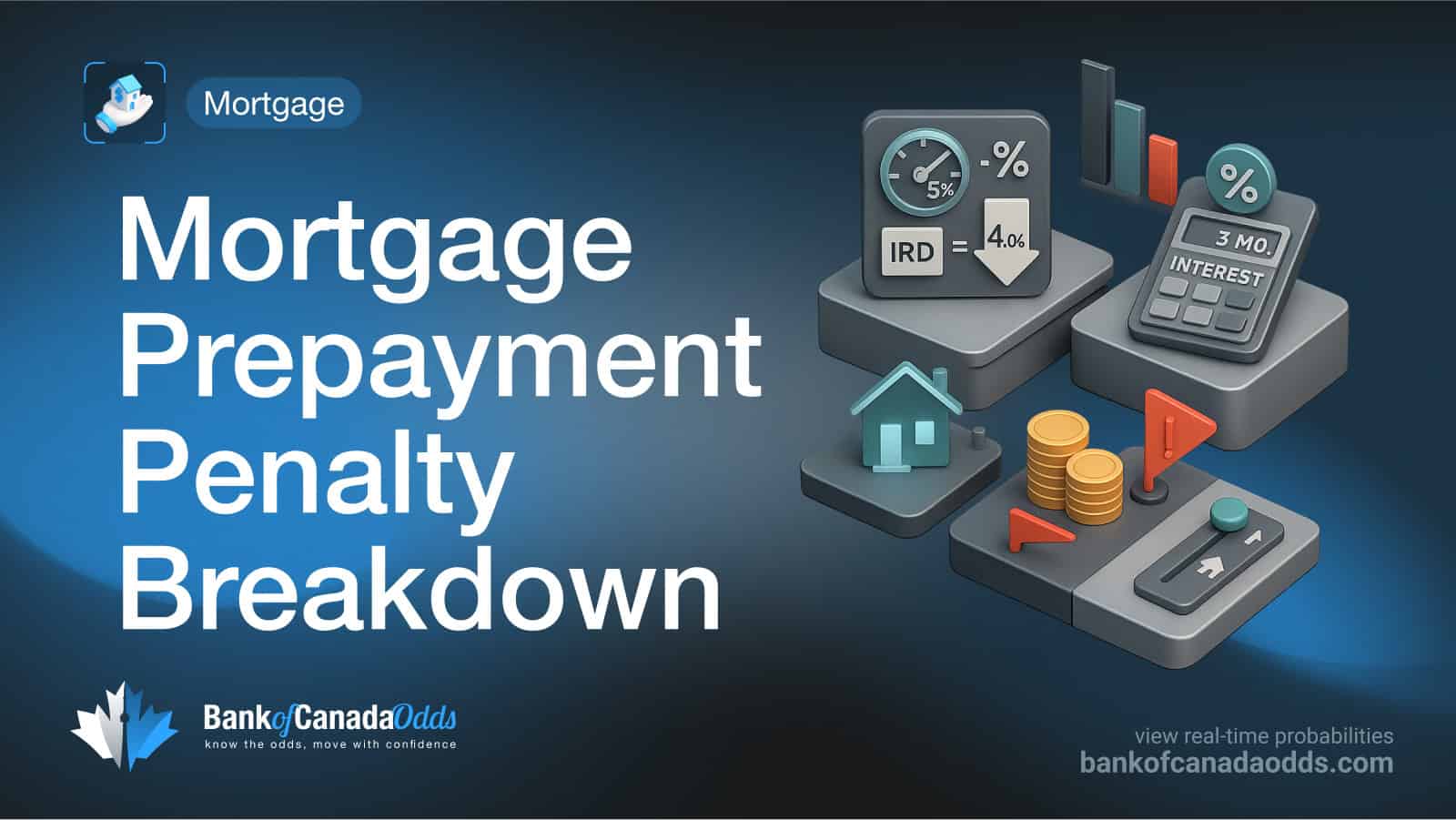
- Interest Rate Differential (IRD): Based on the difference between your rate and current rates, applied to your balance and term.
Example: If your contract rate is 5.0%, the lender’s current 2-year rate is 4.0%, and you owe $300,000 with 2 years left:
IRD = (5.0% – 4.0%) × $300,000 × 2 = $6,000. If 3 months’ interest = $3,750, the penalty = $6,000.
2. Variable-Rate Mortgages
Usually a flat three months’ interest—no IRD.
When Prepayment Pays Off
If your balance is $350,000 at 5.0% and 3 years remain, you could save up to $20,000 in interest by paying early—even after a $6,000 penalty. Use this calculation to compare long-term savings.
How to Avoid or Reduce Penalties
- Use prepayment privileges: Stay within limits.
- Time your move: Align with mortgage maturity.
- Use portability: Transfer your rate to a new home.
- Early renewal: Ask your lender to renew early at lower cost.
- Blend and extend: Combine your old and new rate.
The Fine Print: What to Review
- Prepayment limits: Annual percentage allowed
- Penalty formula: Posted vs. discounted rate
- Rate type: Fixed vs. variable
- Mortgage type: Closed vs. open
Market Context (Fall 2025)
Most Canadian lenders still use posted-rate IRD formulas, which increase penalties. With five-year fixed rates averaging 4.5% and many 2021–2023 mortgages at 5.5%, breaking early can mean a high cost.
Always request a written payout statement before making a decision.
Quick Q&A
Q: Can I switch lenders at renewal without penalty?
Yes. You can switch freely once your term ends.
Q: Why is my IRD penalty so high?
Some banks use posted (not discounted) rates. Ask for a full breakdown.
Q: Are penalties tax-deductible?
Only for rental or investment properties. Speak to a tax advisor.
Q: Can I negotiate a lower penalty?
Possibly—especially if you stay with your lender.
Final Thoughts
Mortgage prepayment can be a smart move—but only if the numbers work. Always review your contract, get your penalty in writing, and consider alternatives like porting or early renewal.
Use trusted tools and resources at BoCOdds.com to monitor rate trends and stay updated on strategies that help you save on interest—not lose it in penalties.
Helpful links: