Every time the Bank of Canada (BoC) makes an announcement regarding its policy rate, Canadians experience the effects in their wallets. Whether you are looking to take out a new personal loan, consolidate debt, or need some extra cash for renovations, the BoC’s announcements affect how much you will end up paying in interest. While many people think of the BoC’s policy rate in terms of mortgage rates, the influence of Bank of Canada personal loan rates is significant across all borrowing types, including lines of credit and other consumer debt.
Understanding the chain reaction of how these changes affect the economy enables you to prepare for future borrowing needs regardless of whether you are preparing to refinance a line of credit, borrow money to renovate your home, or simply manage your day-to-day finances. Because the BoC makes rate announcements several times per year, even the smallest adjustments can have long-lasting effects on your finances.
Key Takeaways
- The Bank of Canada’s policy rate influences borrowing costs across all loan types, including personal loans.
- Variable-rate loans change almost immediately after BoC rate announcements, while fixed-rate loans adjust more gradually.
- BoC decisions are designed to balance inflation and economic growth.
- Understanding BoC trends helps borrowers anticipate interest rate changes and manage loan costs effectively.
The Bank of Canada’s Role in Determining Interest Rates
While the BoC does not determine personal loan rates directly, it sets the overnight rate. This is the rate at which large financial institutions lend to one another. The BoC’s overnight rate serves as a benchmark for nearly all interest rates in the Canadian economy. You can track the probability of upcoming rate changes on our Bank of Canada Odds Dashboard.
When the BoC raises or lowers the overnight rate, it sends a message to financial markets regarding its outlook on inflation, employment, and growth. As a result, banks and credit unions modify their own prime lending rate, ultimately impacting the Bank of Canada personal loan rates that their clients receive.
- When the BoC Raises Rates: Spending decreases because borrowing becomes more expensive. The BoC is attempting to slow down the economy and bring inflation under control.
- When the BoC Lowers Rates: Spending increases because borrowing becomes less expensive. The BoC is attempting to stimulate the economy and encourage consumer spending.
The Impact of Overnight Rate Changes on Personal Loans
After the BoC announces a change in its overnight rate, the effects of the change typically become evident in the banking industry within days. Below is how the change in the overnight rate impacts personal loans.
Variable-Rate Loans
Variable-Rate Personal Loans are linked to the prime rate. If the BoC increases its policy rate, lenders will increase the prime rate. As a result, borrowers with variable loans will experience an increase in the amount of interest paid on their loans and potentially an increase in their monthly loan repayments.
For example, a 0.25% increase in the BoC’s policy rate will generally cause an additional $50 to $60 in annual interest to be charged on a $20,000 variable-rate loan. However, the actual amount will depend on the length of the loan and the borrower’s repayment schedule.
Fixed-Rate Loans
Fixed-Rate Loans are impacted indirectly. They are priced using bond yields and are therefore influenced by market expectations for future BoC rate changes. If investors believe there will be higher inflation or BoC rate increases in the future, then bond yields and subsequently fixed loan rates will increase. Even if the BoC has not yet raised its rate, fixed personal loan rates may rise in anticipation.
Why the Bank of Canada Makes Policy Rate Changes
The BoC’s primary objective is to keep inflation stable by maintaining a target inflation level of approximately 2%. The BoC uses its policy rate to achieve this goal:
- To combat inflation: The BoC increases its policy rate to reduce demand and discourage borrowing.
- To help stimulate the economy: The BoC reduces its policy rate to lower borrowing costs and encourage consumer spending during periods of economic slowdown.
This balance of economic objectives means that the BoC’s policy rate changes provide insight into potential future loan costs for borrowers.
Economic Factors That Guide BoC Monetary Policy Decisions
To guide its decisions, the BoC monitors several key economic indicators, which we analyze in detail in our section on The Six Drivers of monetary policy. Key factors include:
- Inflation and Consumer Price Index (CPI) data
- Employment levels and wage growth
- Consumer spending and business investment
- Global economic conditions and oil prices
Each of these factors can influence whether the BoC decides to raise, hold, or reduce its policy rate at the next announcement.
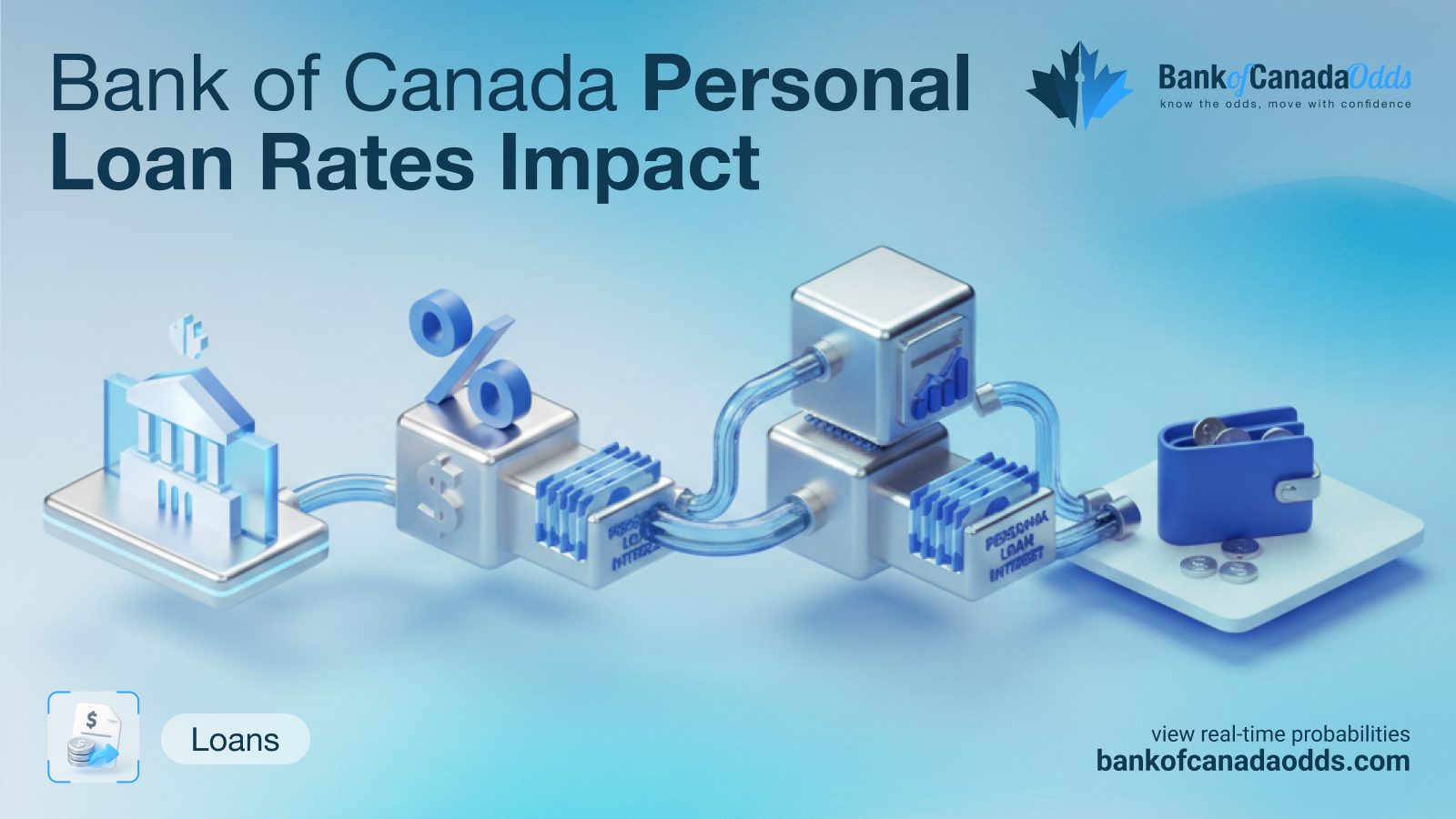
From the Bank of Canada to the Borrower: The Domino Effect
- BoC announces a change in its policy rate.
- Banks and lenders adjust their prime rate.
- Bank of Canada personal loan rates (particularly variable) rise or fall.
- Consumers pay more or less in interest.
This domino effect impacts both borrowers and savers. Higher interest rates can discourage borrowing but can also provide higher returns for savers through products like GICs and savings accounts.
Hypothetical Scenarios
Below are two scenarios that demonstrate how BoC rate changes can impact borrowers.
Scenario 1: Rising Rate Cycle
The BoC increases its policy rate by 0.5% to help cool inflation.
- The prime rate increases from 7.20% to 7.70%.
- A borrower with a $10,000 variable-rate loan will pay approximately $50 more per year.
- Over five years, this equates to about $250 more in total interest.
Scenario 2: Falling Rate Cycle
If the BoC reduces its policy rate by 0.5%, the prime rate decreases.
- A borrower with a $15,000 variable-rate loan could save roughly $75 per year.
- Fixed-rate borrowers may not benefit immediately, but new borrowers could secure lower fixed rates.
These examples show how even small changes in the BoC’s policy rate can affect household budgets.
More Than Just Loans: The Broad Impact of BoC Decisions
The BoC’s rate decisions influence more than just loans. They affect consumer confidence, inflation expectations, and market performance. When the BoC signals a rate cut, consumer spending tends to rise, benefiting retailers and housing markets. Conversely, when it tightens policy, demand cools, easing inflation but slowing growth.
Borrowers who track BoC announcements and statements can gain valuable insights into future financial trends. To understand how these mechanics work in depth, visit our How It Works page.
Preparing for the Bank of Canada’s Decisions
The BoC makes rate decisions eight times per year, and each decision can lead to changes in borrowing costs. Good financial planning means anticipating how these decisions may affect your budget.
Steps to Prepare
- Track BoC meetings: Follow the official schedule or our dashboard updates.
- Know your loan type: Determine if your loan is fixed or variable.
- Build flexibility into your budget: Prepare for potential increases in payments.
- Review lender policies: Some lenders allow switching between fixed and variable rates.
- Consider consolidation: Locking in a fixed rate can offer stability if rates rise.
The Current Environment (2025)
As of Q4 2025, the BoC has kept its overnight rate high as part of ongoing efforts to control inflation. While inflation has moderated, it remains above the 2% target. The BoC has signaled a gradual approach to rate cuts beginning in 2026, contingent on continued progress toward its target.
In this environment, variable loan rates remain elevated, while fixed rates appear to have plateaued as bond yields stabilize. Borrowers can plan strategically by locking in fixed loans before rates drop or choosing variable loans if they expect cuts sooner.
Trends Among Lenders and Borrowers
- Lenders are tightening credit requirements, focusing on credit scores and debt ratios.
- Many consumers are shifting from variable to fixed loans for stability.
- Demand for personal loans has leveled after rapid growth in previous years.
Practical Tips for Borrowers
- Compare lenders to find the most competitive rates.
- Use online calculators to estimate the impact of BoC rate changes.
- Monitor BoC updates to anticipate rate shifts.
- Avoid over-borrowing during rising rate cycles.
- Check loan terms for prepayment penalties or adjustment clauses. The Financial Consumer Agency of Canada offers excellent resources on understanding these terms.
Frequently Asked Questions
Does the BoC control how much my bank charges for a personal loan?
Not directly. The BoC influences the prime rate, which banks use to set Bank of Canada personal loan rates for consumers.
How quickly do lenders respond to BoC announcements?
Usually within days. The prime rate often adjusts immediately following a BoC decision.
Why do fixed and variable loans behave differently?
Variable loans are tied to the prime rate, while fixed loans are priced based on bond yields and long-term expectations.
How often does the BoC make rate decisions?
Eight times per year, roughly every six weeks. You can see the schedule on our Odds Dashboard.
Can I predict what the BoC will do next?
Not with certainty, but you can follow inflation, employment, and policy statements for clues.
Conclusion
The Bank of Canada’s decisions shape Canada’s entire financial landscape, influencing everything from mortgages to personal loans. Understanding how and why the BoC adjusts its policy rate allows borrowers to make informed and strategic financial choices. By monitoring BoC meetings, identifying your loan type, and preparing for potential rate changes, you can minimize costs and stay ahead of Canada’s evolving interest rate environment. If you need further assistance interpreting these trends, feel free to contact us.