With household debt reaching record highs, many Canadians are exploring debt consolidation refinance options to simplify payments and reduce interest costs. Refinancing to consolidate debt can help you save money and regain control—but it also introduces long-term risks. Here’s how debt consolidation through mortgage refinancing in Canada works, when it makes sense, and how to decide if it’s right for you.
What Is Debt Consolidation Through Refinancing?
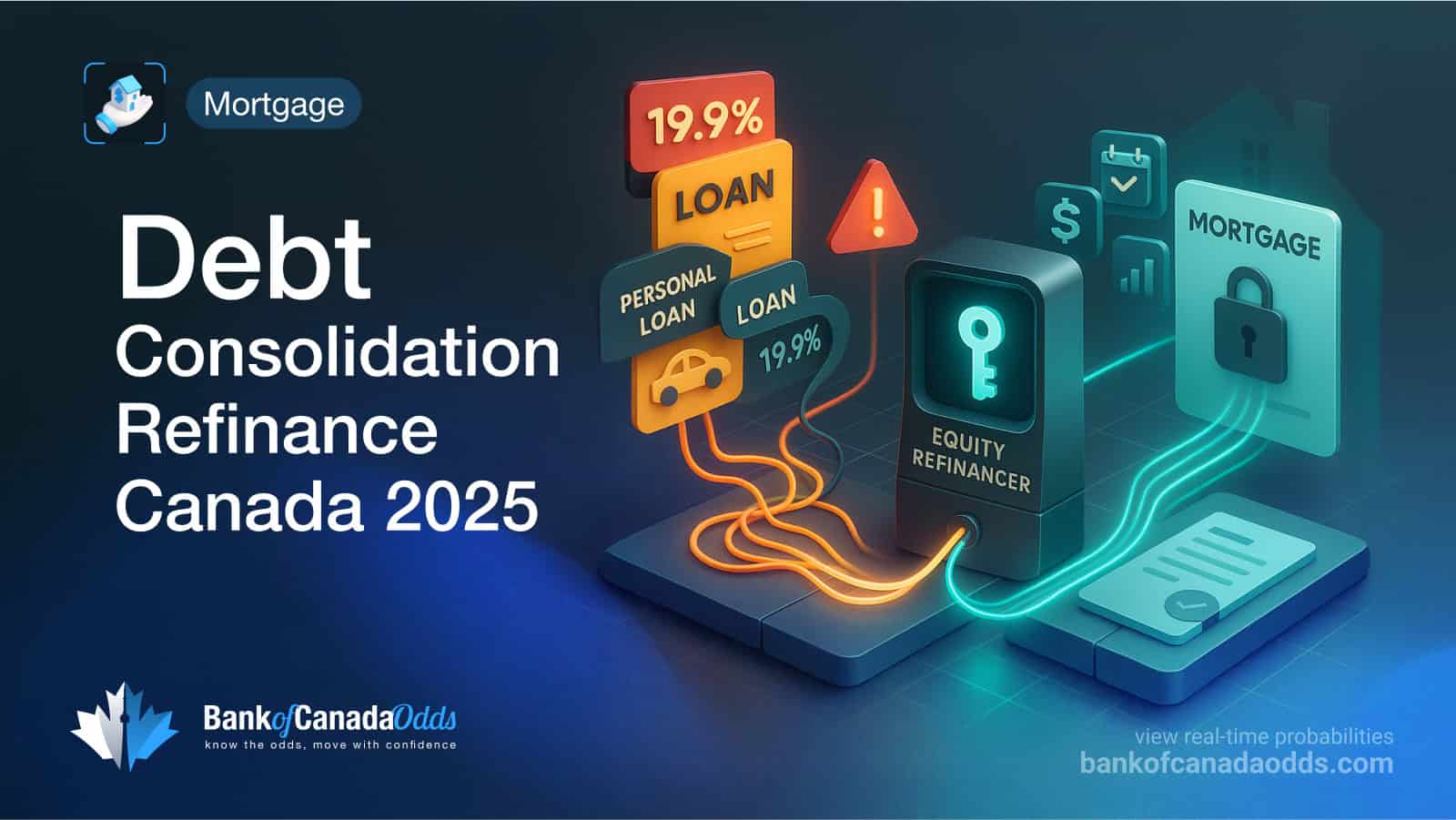
Debt consolidation via refinancing means using your home equity to pay off high-interest debts, such as credit cards, car loans, or personal lines of credit. Instead of managing several bills, you merge them into a single mortgage payment—usually at a much lower interest rate.
Example
You owe:
- $20,000 on credit cards at 19.9%
- $15,000 on a car loan at 8%
- $250,000 remaining on your mortgage at 5.0%
By refinancing to combine these into a new $285,000 mortgage at 4.3%, you could save hundreds per month and simplify your budget.
How a Debt Consolidation Refinance Works
In Canada, you can refinance up to 80% of your home’s appraised value. The new mortgage replaces your old one and pays off other debts. You’ll need a new application, appraisal, and legal documents—similar to any mortgage refinance.
Step-by-Step Process
- Assess your equity: Confirm your home’s current market value with your lender or appraiser.
- Calculate your total debts: Add all high-interest balances you want to pay off.
- Compare rates and lenders: Use WOWA’s refinance calculator or check Nesto for live rate comparisons.
- Apply and finalize: After approval, your new lender pays off your old mortgage and debts, and you begin fresh with one payment.
When It Makes Financial Sense
- You carry high-interest debt: Credit cards at 18–22% make consolidation attractive.
- You have solid home equity: Combined balances must remain under 80% of your home’s value.
- You want simplicity: One predictable payment improves cash flow and organization.
- You plan to stay long-term: Refinancing costs take time to recover through savings.
When to Think Twice
- Extending your amortization too far: Smaller monthly payments can lead to more total interest over time.
- Approaching retirement: Taking on new long-term debt later in life may strain your finances.
- Persistent overspending: Refinancing without changing habits often rebuilds debt.
- Limited equity: If home prices dip, you may not qualify for the full amount needed.
Costs to Expect
- Appraisal: $300–$600
- Legal fees: $800–$1,200
- Title insurance and administration: Depends on lender
These fees can usually be rolled into your mortgage balance.
Qualification & Tax Notes
- Stress test: You must qualify under the federal OSFI Minimum Qualifying Rate (MQR)—the higher of your contract rate +2% or 5.25%.
- Tax implications: Personal interest isn’t deductible, but debt used for investments may qualify. Consult a tax advisor.
Market Context (October 2025)
As of October 2025, five-year fixed mortgage rates range from 3.8% to 5.0%, while variable rates average between 3.6% and 4.9%. The Bank of Canada’s recent 0.25% rate cut created an ideal window for refinancing before potential market adjustments. Check Ratehub or NerdWallet for current market comparisons.
Benefits of Debt Consolidation Refinance
- Lower overall interest: Swap 19–20% credit rates for ~4–5% mortgage rates.
- Single monthly payment: Simplifies cash flow and budgeting.
- Improved credit: Paying off revolving balances can boost your score.
- More breathing room: Free up monthly cash for savings or emergencies.
Risks and Drawbacks
- Turning unsecured into secured debt: Your home becomes collateral.
- Higher long-term costs: Extending the amortization increases total interest paid.
- Less flexibility: Missing a mortgage payment is riskier than missing a card payment.
Quick Q&A
Q: How much equity do I need?
At least 20% equity (mortgage + new funds ≤ 80% of appraised value).
Q: Do I need to requalify?
Yes, the mortgage stress test and income verification apply.
Q: What debts can I include?
Most unsecured debts like credit cards and personal loans. Vehicle and student loans vary by lender.
Q: Will refinancing hurt my credit?
Possibly a short-term dip, but paying down debt improves long-term credit.
Q: How long does refinancing take?
Usually 2–4 weeks, depending on lender processing and appraisal timelines.
Conclusion
Debt consolidation refinance in Canada can be a smart move—if approached strategically. Done right, it simplifies your finances, lowers interest, and strengthens your credit profile. But extending your mortgage or ignoring spending habits can erase those benefits.
With BoC policy easing and lenders offering competitive rates, now may be a good time to evaluate your refinancing options. Track BoC Rate Odds, explore our How It Works section, or subscribe for weekly rate updates to make data‑driven debt decisions.