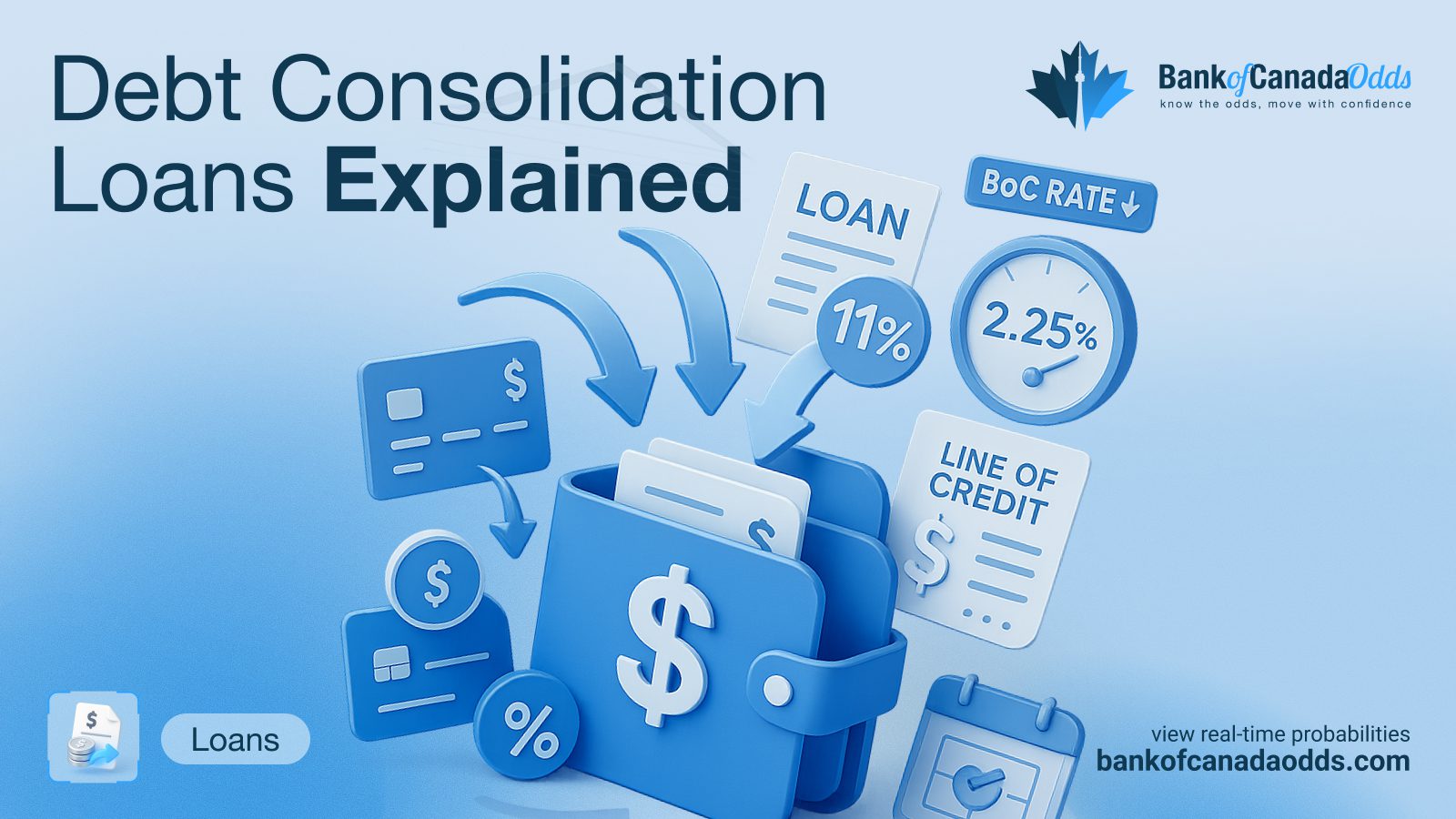
Many Canadians struggle to manage multiple debts such as credit cards, personal loans, or lines of credit. Debt consolidation loans provide a straightforward way to regain control by combining several debts into a single loan, often at a lower interest rate.
This approach can simplify your budget, improve your credit score over time, and reduce the total interest you pay each year. With the Bank of Canada maintaining specific rate targets in 2025, more consumers are exploring debt consolidation to reduce monthly payments and prepare for future policy changes.
Key Points
- A debt consolidation loan combines multiple high-interest debts into one payment.
- Fewer debts and lower interest rates can ease financial stress.
- To qualify, you will need good credit, stable income, and a debt-to-income ratio under 45%.
- The Bank of Canada’s interest rate decisions directly affect consolidation loan rates.
How Debt Consolidation Loans Work
A debt consolidation loan lets you borrow money to pay off your existing debts. You then make one monthly payment, typically at a lower rate, toward your new loan.
Example
If you owe $15,000 across three credit cards at 20% interest, consolidating into a personal loan at 11% could save over $1,000 annually in interest.
Debt consolidation is especially useful if you are juggling several creditors or multiple payment due dates.
Types of Debt Consolidation Loans
1. Personal Unsecured Loan
These are offered by banks, credit unions, and online lenders. Approval depends heavily on your credit history and income.
2. Home Equity Loan or Line of Credit (HELOC)
This option is secured by your home equity. It offers lower interest rates but comes with higher risk because missed payments could result in losing your property.
3. Credit Card Balance Transfer
This moves multiple card balances to one lower-interest card. This is often accompanied by an introductory offer. It is great for short-term consolidation if managed carefully.
Each option has pros and cons, but unsecured personal loans remain the most accessible choice for most borrowers.
Benefits of Debt Consolidation
- One Monthly Payment: Simplifies budgeting by reducing multiple due dates.
- Lower Interest Costs: Replaces high-rate credit cards with a lower-rate loan.
- Faster Debt Repayment: More of your payment goes toward principal, reducing overall payoff time.
- Better Credit Score: Consistent payments can boost your credit score over time.
Drawbacks to Consider
- Qualification Standards: Competitive rates typically require a credit score of 660 or higher.
- Potential Fees: Origination or early repayment fees may apply.
- Recurring Debt Risk: Continuing to use old credit lines can worsen debt problems.
Commit to disciplined spending habits before and after consolidation to make the process successful. For more on managing debt, the Financial Consumer Agency of Canada offers excellent resources.
Eligibility Requirements
Lenders assess your credit score, income, and overall debt before approving debt consolidation loans. Generally, you will need:
- A credit score of 660+ for prime rates.
- A debt-to-income ratio below 40% to 45%.
- Proof of steady income and employment.
How to Increase Your Approval Odds
- Pay down existing debts before applying.
- Avoid multiple credit applications in a short period.
- Submit accurate financial documentation.
- Compare offers from multiple lenders.
The Bank of Canada’s Impact on Consolidation Loans
The Bank of Canada (BoC) sets the policy rate that influences all borrowing costs in Canada. When the BoC changes its rate, lenders adjust their prime lending rate, which affects consolidation loan interest rates. To understand the economic factors behind these decisions, read about The Six Drivers of monetary policy.
As of late 2025, the BoC’s policy rate remains elevated to combat inflation. Many borrowers are locking in lower fixed rates now in anticipation of potential rate cuts in 2026. You can track the likelihood of these cuts on our Odds Dashboard.
Example: A 0.25% BoC rate decrease could reduce payments by $15 to $25 monthly on a $10,000 loan depending on the term and lender.
When Debt Consolidation Makes Sense
Debt consolidation is ideal if you:
- Hold high-interest debt, such as credit cards over 15% to 20%.
- Qualify for a lower rate based on your credit.
- Are committed to reducing future borrowing.
- Want to simplify your payments into one manageable amount.
If your credit score is low or debts exceed 50% of your income, consider a credit counselling agency or a debt management plan before applying.
Common Mistakes to Avoid
- Taking on new credit after consolidating.
- Ignoring loan fees that increase total cost.
- Failing to compare lenders and terms.
- Consolidating without changing spending habits.
FAQs
Will debt consolidation affect my credit score?
A small drop may occur initially due to a credit inquiry, but regular on-time payments usually improve your score over time.
How much can I borrow?
Most lenders offer between $5,000 and $50,000, depending on your income and creditworthiness.
Are home equity loans better than consolidation loans?
HELOCs often have lower rates but put your home at risk if payments are missed. You can check current benchmark rates on the Bank of Canada Rates page.
Can I consolidate debt with bad credit?
Some credit unions and online lenders work with fair-credit borrowers, though interest rates will be higher. Improving your credit before applying can help secure better terms. For more answers to common questions, visit our FAQ section.
Conclusion
Debt consolidation loans provide Canadians with a clear path toward financial stability by simplifying payments and reducing interest costs. In 2025, they remain an effective strategy for managing high-interest debt while preparing for future Bank of Canada policy changes.
By comparing offers, practicing financial discipline, and understanding the long-term implications, borrowers can convert multiple debts into one manageable payment, moving closer to true financial freedom. If you have questions about how rates might change in the near future, feel free to contact us.