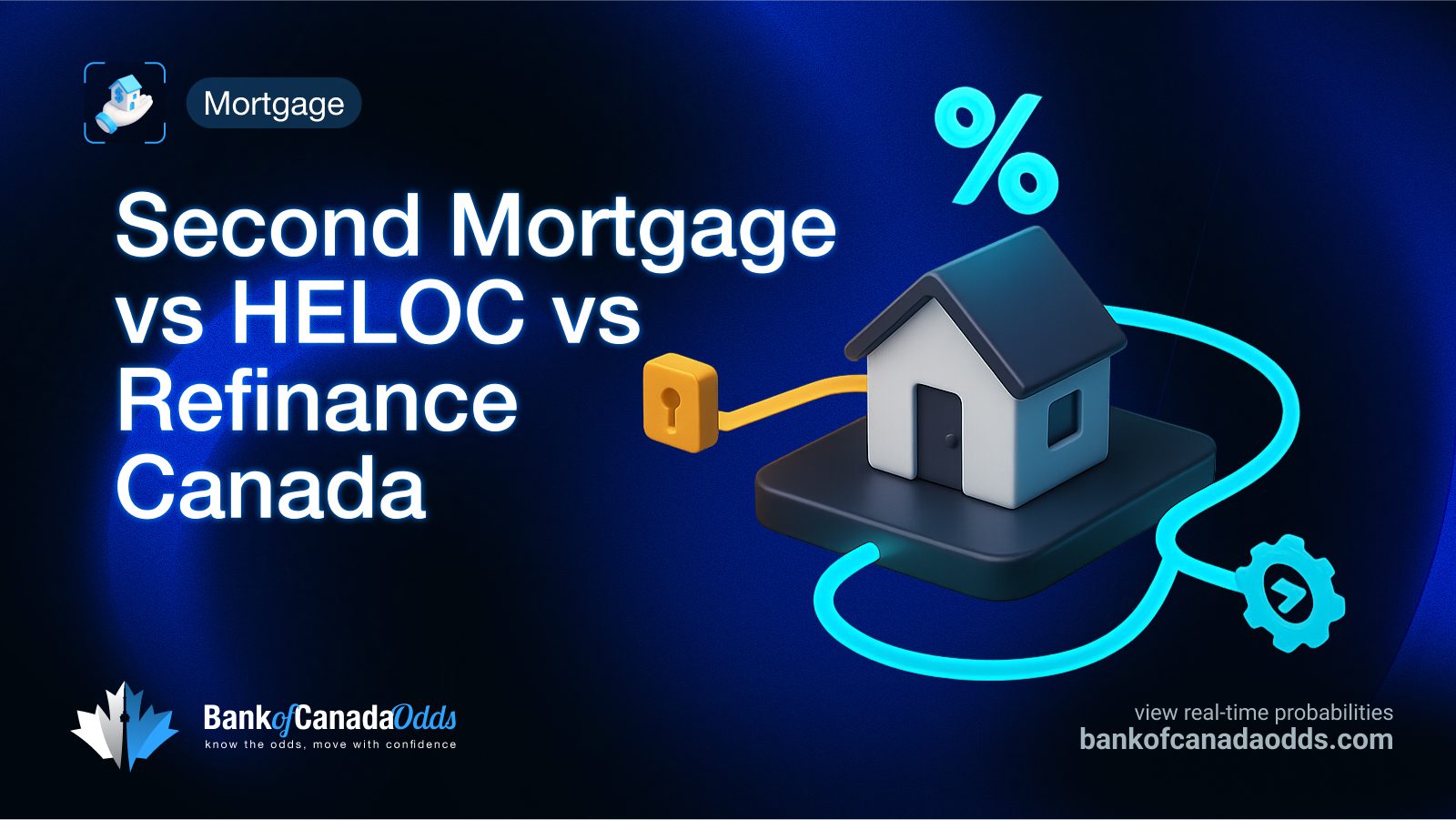
Second mortgage vs HELOC vs refinance Canada is a key decision for homeowners who need access to home equity. Each option taps into your property’s value but with different costs, benefits, and risks. In a market where the Bank of Canada’s (BoC) rate changes directly influence borrowing costs, understanding these tools can help you save thousands and avoid financial strain.
What Is a Second Mortgage?
A second mortgage is a loan taken out against your home while your first mortgage is still in place. It’s “second” because the lender’s claim comes after your primary mortgage if you default.
Key Features
- Structured as a lump-sum loan.
- Interest rates are typically higher than first mortgages.
- Fixed repayment schedule with predictable monthly payments.
- Useful for borrowers with lower credit or high debt loads.
When It Makes Sense
- You need a large one-time sum (renovations, debt consolidation, medical bills).
- You don’t want to break your first mortgage and pay penalties.
- You can’t qualify for a refinance or HELOC due to credit score or income issues.
Pros
- Access equity without touching your primary mortgage.
- Fixed structure makes budgeting easier.
- Often faster to arrange than a full refinance.
Cons
- Higher interest rates than a first mortgage.
- Less flexible — no revolving credit.
- Riskier: in default, the second lender is repaid only after the first.
What Is a HELOC?
A home equity line of credit (HELOC) is a revolving line of credit secured by your home. Think of it as a large credit card backed by your property.
Key Features
- Borrow what you need, when you need it.a
- Interest-only payments are common, though you can pay down principal anytime.
- Rates are variable and tied directly to BoC policy rate changes.
- Flexible structure but requires financial discipline.
When It Makes Sense
- You need ongoing access to funds (projects, education, emergencies).
- You want flexibility in borrowing and repayment.
- You’re comfortable with variable rates that rise or fall with BoC decisions.
Pros
- Highly flexible: borrow and repay repeatedly without reapplying.
- Interest-only payments keep short-term costs low.
- Lower interest than unsecured debt like credit cards.
Cons
- Payments rise immediately when BoC raises rates.
- Easy to overborrow if you lack discipline.
- No fixed repayment schedule, which can extend debt indefinitely.
What Is a Mortgage Refinance?
Refinancing replaces your current mortgage with a new one, often at a higher principal, to access equity.
Key Features
- Can reset your amortization period and repayment schedule.
- Typically offers lower rates than second mortgages.
- May involve penalties, legal, and appraisal fees.
- Lets you consolidate multiple debts into one manageable payment.
When It Makes Sense
- You can qualify for a better rate than your existing mortgage.
- You want to consolidate high-interest debt at a lower rate.
- You plan to stay in your home long enough to offset fees.
Pros
- Lowest interest rates of the three options (in most cases).
- Opportunity to restructure debt strategically.
- Simplifies finances with a single monthly payment.
Cons
- Breaking your mortgage early can trigger penalties.
- High upfront costs for legal, appraisal, and admin fees.
- Extending amortization increases total interest over time.
Comparing Second Mortgage vs HELOC vs Refinance Canada
| Feature | Second Mortgage | HELOC | Refinance |
| Access to Funds | Lump sum | Revolving credit | Lump sum |
| Interest Rate | Higher | Variable, BoC-linked | Lower (than 2nd mortgage) |
| Flexibility | Low | High | Medium |
| Costs & Fees | Moderate | Low upfront | Higher (penalties, legal) |
| Best For | One-time needs | Ongoing access | Restructuring debt |
This table shows why no single option is “best” for everyone. Your choice depends on your cash flow, tolerance for risk, and expectations about interest rates.
How BoC Rate Decisions Influence the Choice
- Second Mortgages: Rates are less directly tied to BoC moves but still influenced by credit markets. Provide predictability if fixed.
- HELOCs: Most sensitive to BoC policy. Every hike or cut changes your payments almost immediately. Best for those expecting stable or falling rates.
- Refinancing: Timing around BoC decisions is critical. Locking in before hikes can save thousands, while waiting for cuts can unlock better deals.
See live Bank of Canada rate odds at BoC Odds Tracker to plan your move.
Case Study: Choosing the Right Option
A homeowner in Vancouver needs $80,000 for renovations:
- Second Mortgage: Higher interest, predictable payments, no need to break first mortgage.
- HELOC: Flexible withdrawals, variable payments that could rise if BoC hikes.
- Refinance: Lowest rate, but with $6,000 in penalties and fees.
They choose the HELOC because they only plan to borrow in smaller amounts and expect BoC to hold rates steady. If they had needed the full $80,000 upfront over a long period, a refinance might have been the better choice.
FAQs
- Can I have both a mortgage and a HELOC? Yes. Many lenders offer combined mortgage + HELOC products if you have enough equity.
- Which option is cheapest? Usually refinancing, but only if you stay long enough to offset the fees.
- What happens if BoC hikes rates? HELOC payments increase immediately. Refinances on fixed terms are protected. Second mortgages often carry fixed rates but higher from the start.
- How much equity do I need to qualify? Generally, you must retain at least 20% equity after borrowing.
- Is a second mortgage risky? Yes — because it’s subordinate to your first mortgage, lenders charge higher rates, and default could mean losing your home.
Risks to Consider
- Market risk: Rates may not move as expected, leaving you with higher costs.
- Overborrowing: HELOCs are convenient but can lead to excessive debt.
- Penalty risk: Refinances often involve prepayment penalties that eat into savings.
- Equity erosion: Taking too much out of your home reduces your safety buffer if housing prices fall.
Conclusion
Second mortgages, HELOCs, and refinances all unlock your home’s value but serve different needs. The right choice depends on your goals, risk tolerance, and BoC rate trends. By comparing features, costs, and timing, Canadians can choose the strategy that best aligns with their borrowing needs and long-term plans. Use tools like Ratehub.ca or WOWA to compare real-time rates.