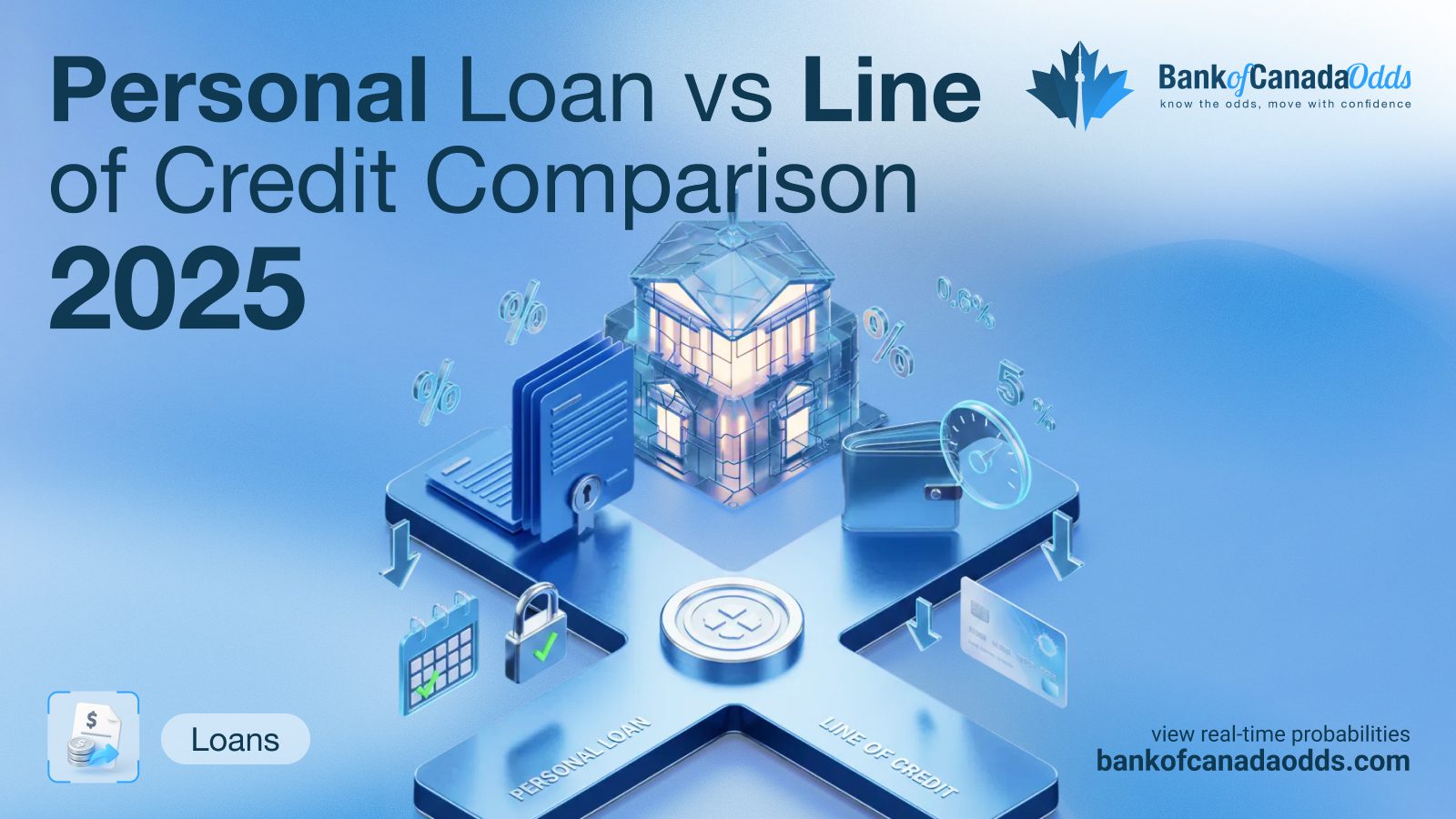
Whether you are looking to buy something new, consolidate debt, or handle an unexpected expense, there are two main ways to get the money you need: a personal loan vs line of credit. Both tools help you access funds, but they operate differently in terms of flexibility, repayment, and cost.
Understanding how these products work and how Bank of Canada rate hikes impact their affordability will help you determine which borrowing option fits your financial goals in 2025.
Key Takeaways
- Personal loans offer fixed payments for a set term, while lines of credit provide ongoing access to funds.
- Lines of credit typically carry variable rates tied to the Bank of Canada’s policy rate.
- Personal loans are best for large, one-time purchases, whereas lines of credit suit ongoing or unpredictable expenses.
- In 2025, Bank of Canada rate hikes will affect both options, but variable-rate lines of credit will see changes more quickly.
What Is a Personal Loan?
A personal loan is a lump-sum installment loan where you receive a fixed amount and repay it with equal monthly payments over a set period, usually from 1 to 5 years. Most Canadian personal loans have fixed interest rates, though variable options exist.
Pros of a Personal Loan
- Predictable monthly payments
- Defined repayment term with a clear payoff date
- Often lower interest rates than credit cards
- Useful for debt consolidation or large purchases
Cons of a Personal Loan
- You cannot re-borrow funds once repaid
- Early repayment penalties may apply
- Approval requires good credit and income stability
Example: Borrowing $15,000 at 9% over three years results in payments of about $477 per month, with roughly $1,172 in total interest.
What Is a Line of Credit?
A line of credit (LOC) is a revolving borrowing option that allows you to access funds up to a pre-set limit. You only pay interest on the amount you use, and once you repay it, the funds become available again.
Most lines of credit in Canada have variable interest rates, which change with the lender’s prime rate. This prime rate is linked directly to the Bank of Canada’s overnight rate.
Pros of a Line of Credit
- Flexible access to funds anytime
- Interest charged only on the amount borrowed
- Can be reused after repayment
- Ideal for emergencies or fluctuating expenses
Cons of a Line of Credit
- Payments rise when the BoC raises rates
- Easy to overborrow or carry long-term debt
- Paying only interest delays principal repayment
Example: Using a $10,000 LOC at Prime + 3% (about 10.7% in early 2025) would cost around $89 per month in interest if the balance is fully used.
Comparing Key Features: Personal Loan vs Line of Credit
| Feature | Personal Loan | Line of Credit |
| Structure | One-time lump sum | Revolving credit (reusable) |
| Repayment | Fixed installments | Flexible, interest-only or variable payments |
| Interest Rate | Usually fixed (some variable) | Always variable (linked to BoC rate) |
| Term | Fixed (1 to 5 years typical) | Open-ended, remains active if payments made |
| Purpose | One-time needs like renovations or debt consolidation | Ongoing needs or emergency use |
| Reaction to BoC changes | Gradual, affects new loans | Immediate, affects existing balances |
How Bank of Canada Rate Changes Affect Borrowers
Bank of Canada rate hikes or cuts directly impact variable-rate products like lines of credit and indirectly affect new fixed-rate personal loans. When the BoC raises its policy rate, prime rates increase, causing line-of-credit payments to rise quickly. Fixed personal loans stay stable for existing borrowers but may carry higher rates for new ones.
To see how these rates are determined, check out our explanation of The Six Drivers of monetary policy.
Rate Outlook for 2025
The BoC has signaled potential rate cuts later in 2025 if inflation continues to cool. Variable-rate borrowers may benefit first, while fixed-rate borrowers could see lower rates on new applications in the following months. You can track the probability of these cuts on our Bank of Canada Odds Dashboard.
When to Choose a Personal Loan
You should consider choosing a personal loan when you:
- Need a lump sum for a specific purpose, such as a home renovation or car purchase.
- Want predictable monthly payments.
- Prefer a defined end date for your debt.
- Qualify for low fixed rates based on strong credit.
Personal loans provide structure and discipline, helping borrowers stick to a clear payoff plan. For more on loan basics, the Financial Consumer Agency of Canada offers great resources.
When to Choose a Line of Credit
You should consider a line of credit when you:
- Need flexible borrowing for irregular expenses.
- Expect to borrow and repay at different times.
- Want access to emergency funds.
- Can handle payment changes from variable rates.
Lines of credit are especially useful for self-employed individuals or homeowners who experience income fluctuations.
Combining Both Options
Some borrowers use both: a personal loan for large, defined expenses and a smaller line of credit for short-term needs. For example, consolidating $15,000 in credit card debt with a fixed-rate personal loan while keeping a $5,000 line of credit for emergencies. This combination provides balance—stable repayments on major debt and flexibility for unexpected costs.
2025 Example: Cost Comparison
For a $20,000 home renovation in 2025:
- Personal loan: 8.5% fixed for 4 years equals roughly $492 per month, with total interest near $3,600.
- Line of credit: Prime + 3% (10.7%) equals roughly $178 per month interest-only, leading to a higher total cost if principal repayment is delayed.
While LOCs appear cheaper upfront, personal loans often save money over time if payments are consistent.
Practical Tips for Borrowers
- Monitor BoC meetings: Rate announcements occur eight times a year and influence variable rates quickly. See the schedule on our How It Works page.
- Use LOCs responsibly: Avoid using them for day-to-day purchases.
- Compare fixed rates: Even a 1% difference can mean big savings over the loan’s term.
- Pay more than the minimum: Always reduce the principal on lines of credit.
- Match the product to your needs: Use fixed loans for planned expenses and LOCs for flexibility.
FAQs
Which is cheaper: a personal loan vs line of credit?
Personal loans usually have lower fixed rates, but lines of credit can be cheaper short-term if used carefully and repaid quickly.
Can I hold both?
Yes, many borrowers use both for flexibility, but keep total debt manageable.
Do I need collateral?
Most personal loans are unsecured, while home equity lines of credit (HELOCs) are secured by property. You can read more about borrowing costs on the Bank of Canada website.
Which is easier to qualify for?
Lines of credit often require higher credit and income; personal loans have simpler qualification criteria.
Will BoC rate cuts help?
Yes, rate cuts reduce variable interest costs first, benefiting line-of-credit users before new fixed-loan borrowers.
Conclusion
Choosing between a personal loan vs line of credit in 2025 depends on your borrowing goals and rate outlook. If you prefer structure and certainty, a fixed-rate personal loan is best. If you value flexibility and expect rates to drop, a line of credit offers adaptability.
As the Bank of Canada moves through its next policy phase, staying informed on rate trends will help you make smarter borrowing decisions and manage debt efficiently. If you need help tracking these trends, check our Tools Coming Soon page for new features.