Government-backed business loans remain some of the most accessible and affordable financing options available to Canadian small businesses in 2026. Designed to support growth, cash-flow stability, innovation, and exporting, these programs offer more flexible underwriting, competitive interest rates, and longer repayment terms compared to traditional bank loans.
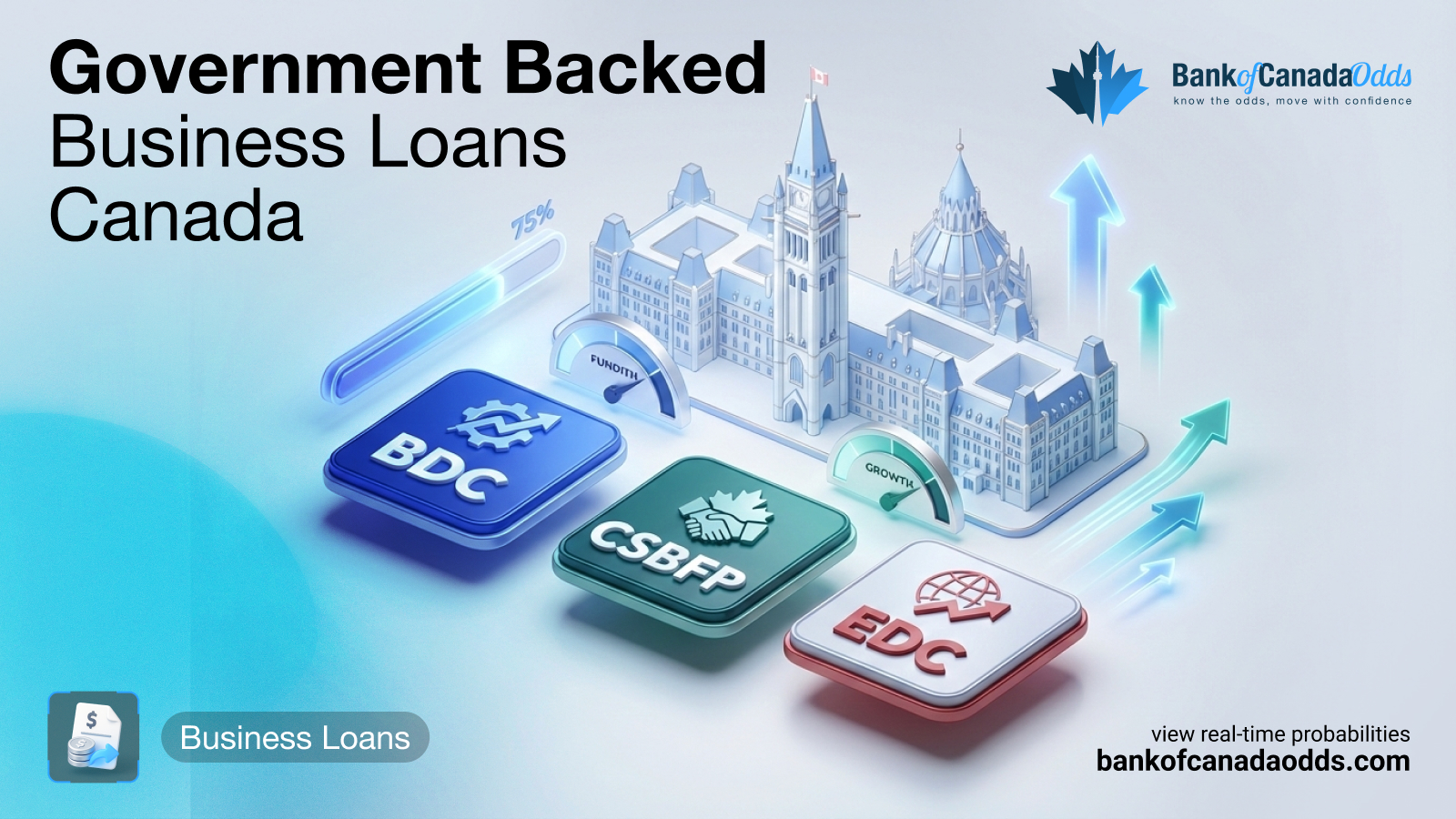
Whether your business needs capital to scale, recover, hire staff, invest in technology, or expand internationally, government programs such as BDC, EDC, the Canada Small Business Financing Program (CSBFP), and provincial loan initiatives continue to play a critical role in helping entrepreneurs succeed.
This guide breaks down the main types of government-backed business loans available, how they work, eligibility requirements, and what small businesses can expect in 2026 regarding interest rates and economic trends. For real-time data on how interest rate changes might impact your loan costs, check our Bank of Canada interest rate dashboard.
Key Takeaways
- Government-backed loans often provide competitive interest rates and longer repayment terms.
- BDC and the Canada Small Business Financing Program (CSBFP) are the primary sources of capital for SMEs in 2026.
- CEBA Update: The final repayment deadline for outstanding CEBA term loans is December 31, 2026.
- Government programs are ideal for businesses lacking collateral or needing support during growth or transition.
- These loans emphasize financial viability, cash-flow forecasting, and demonstrated business purpose.
Business Development Bank of Canada (BDC)
The Business Development Bank of Canada (BDC) is Canada’s key federal agency focused specifically on assisting Canadian small and medium-sized businesses. In contrast to the banking system, BDC operates as a development agency. Therefore, it is designed to assume greater levels of risk and to support businesses that may not be eligible for conventional financing.
BDC Loan Types
- Small Business Loan: Financing of up to $100,000 available online, commonly used for cash-flow support, working capital, marketing, and equipment purchases. Larger amounts are available through advisory support.
- Growth and Expansion Financing: Financing for the purchase of new technologies, hiring, market entry, and acquisitions.
- Equipment Financing: Asset-based lending for machinery, vehicles, and other equipment.
- Commercial Property Financing: Long-term, stable financing options for purchasing, expanding, or renovating commercial real estate.
- Innovation and Venture Capital Loans: Targeted at high-growth, technology-based companies.
- Transition Financing: For management buyouts, owner transitions, and restructuring.
Key Benefits of Using a BDC Loan
- Greater willingness to accept risk compared to banks.
- Flexible loan amortization periods (typically 7 to 12 years).
- Ability to match-finance alongside a company’s banking partner.
- Non-dilutive capital preserves business ownership.
- No personal collateral required for certain loan types.
- Advisory services available in addition to financing.
When to Use a BDC Loan
- Companies seeking to grow and expand.
- Businesses investing in technology or equipment.
- Companies needing long-term, affordable capital.
- Businesses with limited collateral but strong fundamentals.
For more details on their current offers, you can visit the official BDC website.
Canada Small Business Financing Program (CSBFP)
Often overlooked, the CSBFP is a loan sharing program between the government and financial institutions. Under this program, the Government of Canada shares the risk with your lender, making it easier for you to get approved.
In 2026, the CSBFP allows businesses to access up to $1.15 million in financing. This includes:
- Up to $1,000,000 for term loans (land, buildings, and equipment).
- Up to $150,000 for lines of credit (working capital and operating costs).
This program is delivered directly through banks and credit unions, not the government itself. It is an excellent option for businesses that need significant capital but lack the traditional security required by banks.
Export Development Canada (EDC)
Export Development Canada (EDC) is an agency that provides financing to exporters and businesses seeking international trade opportunities.
Financing Options Offered Through EDC
- Export Guarantee Program: Allows businesses to secure bank loans by guaranteeing up to 75% of the loan.
- Working Capital for Exporters: Provides financing to meet large international orders and production requirements.
- Insurance of Receivables: Protects exporters from non-payment by foreign customers.
- Bonding and Surety Services: Helps businesses secure international contracts.
Who Should Use EDC Financing
- Manufacturers.
- Technology companies serving global clients.
- Import/export businesses.
- Businesses growing internationally.
CEBA Status in 2026
The Canada Emergency Business Account (CEBA) program has officially ended for new applications. However, for businesses that still hold an outstanding CEBA balance that was converted into a 3-year term loan, 2026 is a critical year.
The Final Deadline: If you did not qualify for forgiveness or pay off the loan by the previous deadlines, your outstanding balance is currently accruing interest at 5% per annum. The full principal amount is due by December 31, 2026. Failure to repay by this date may result in the loan being sent to the CRA’s collections program.
If you are concerned about repayment or interest rates impacting your cash flow, stay updated on economic trends by subscribing to our updates.
Provincial and Municipal Loan Programs
Across Canada, provincial agencies provide additional financing options for small businesses. These often serve as successors to pandemic-era relief funds, focusing now on growth and innovation.
Common Provincial Options
- Futurpreneur Canada: Startup financing and mentorship for young entrepreneurs (ages 18 to 39).
- Community Futures: Rural and regional small-business loans across many provinces.
- Investissement Québec: Wide range of SME loans and guarantees for Quebec-based businesses.
- Alberta Innovates: Funding for tech development and R&D.
- Invest Nova Scotia Programs: Support for business growth and innovation.
Typical Uses
- Startup capital.
- Technology upgrades.
- Hiring and training.
- Export expansion.
Eligibility Requirements for Government-Backed Loans
While each program has unique qualifications, most require the following:
- Canadian ownership and operation.
- Reasonable credit history (personal and business).
- Solid cash-flow forecasts.
- Clear loan purpose.
- Financial statements or projections.
- Demonstrated economic benefit (jobs, growth, innovation).
Pros and Cons of Government-Backed Loans
Pros
- Lower interest rates compared to private lending.
- Longer amortization periods help cash flow.
- Flexible qualification criteria.
- Less emphasis on personal collateral.
- Designed to support growth and innovation.
Cons
- Longer application timelines than banks.
- More documentation required.
- Some programs restricted to specific sectors or regions.
Frequently Asked Questions (FAQ)
Are government-backed loans easier to get than bank loans?
Often yes. These programs are designed to support SMEs, especially those lacking collateral or strong credit, by mitigating the risk for the lender.
Is CEBA still available?
No, CEBA is closed to new applicants. However, outstanding loans must be fully repaid by December 31, 2026.
Do government loans require personal guarantees?
BDC and provincial loans may require them, but requirements vary. The CSBFP often requires a personal guarantee but limits it to a percentage of the loan amount.
Can startups qualify?
Yes. Startups can qualify, especially through BDC, Futurpreneur, and the CSBFP. Contact us if you need help understanding which economic factors might affect your startup’s borrowing costs.
Conclusion
Government-backed business loans remain one of the most powerful financing tools available to Canadian entrepreneurs in 2026. With competitive rates, flexible terms, and strong support for growth and innovation, these programs offer a pathway for businesses to secure the capital they need. Whether you are scaling, stabilizing, or taking your operations global, reviewing your eligibility for BDC, EDC, or CSBFP funding is a smart financial move.
Stay ahead of market shifts and interest rate news that could affect your loan terms. Visit our Bank of Canada Dashboard for the latest data.