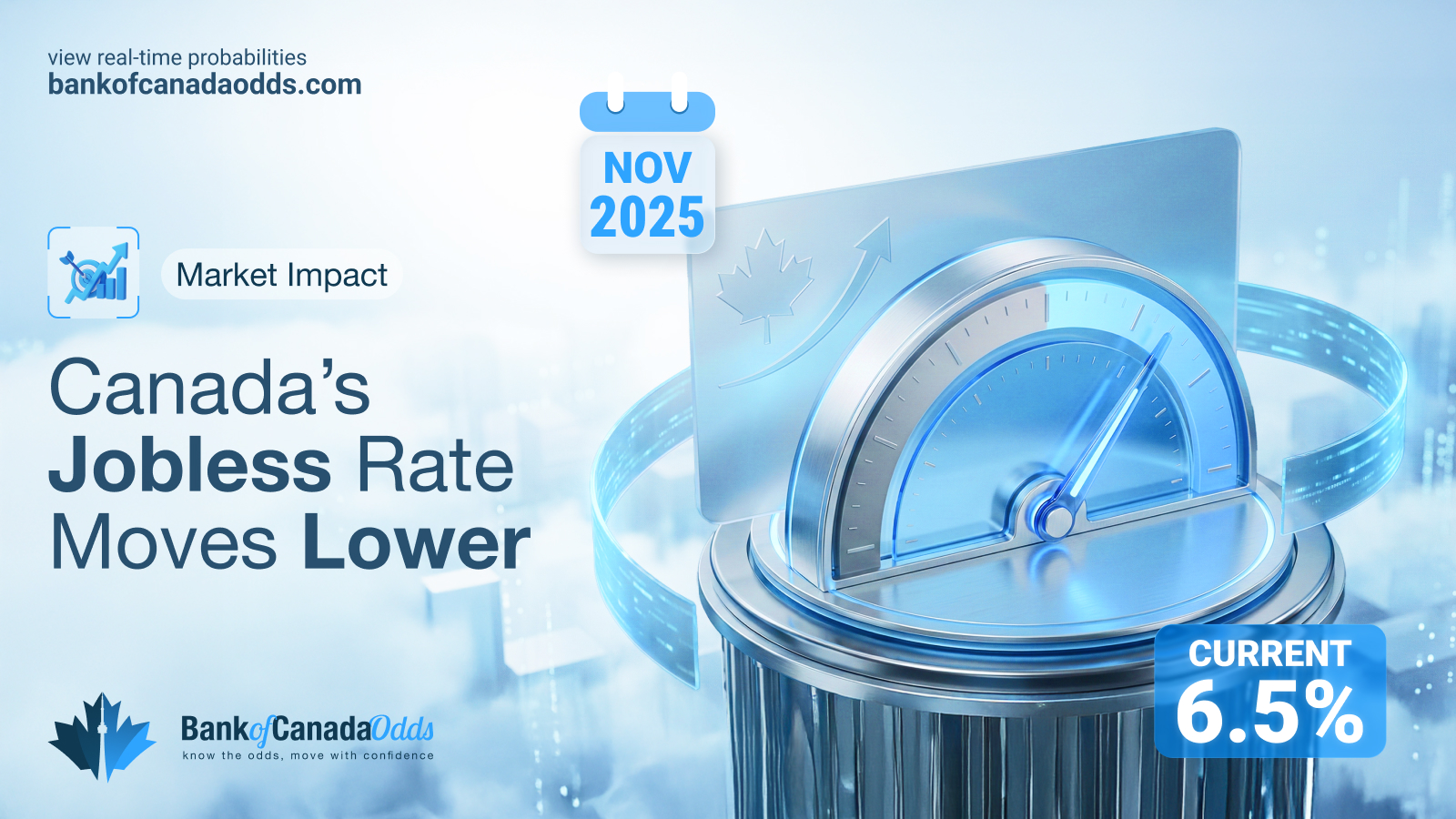
Canada job market outlook improved late in the year as unemployment dipped to 6.5% in the latest labour market report, according to Statistics Canada. The decline reflected firmer hiring conditions ahead of year-end, with employment rising modestly and gains concentrated in full-time positions and several service-sector industries.
The report marked a stronger-than-expected print after a period of uneven labour market data. While job growth earlier in the year had slowed, December hiring showed renewed momentum, helping to stabilize the unemployment rate and ease immediate concerns about a sharp labour market deterioration.
Canada Job Market Outlook and the Bank of Canada
The improvement in labour conditions quickly shifted market sentiment. Expectations for a December interest rate cut faded following the release, as the Bank of Canada had already lowered its policy rate to 2.25% on October 29. With employment showing resilience, policymakers face less urgency to provide additional near-term easing.
Economists broadly view the report as reinforcing a pause at the next policy decision. Although hiring strengthened at the margin, the labour market is no longer tightening aggressively, allowing the Bank of Canada to remain patient while monitoring incoming inflation data.
Inflation stood at 2.2% in October, close to the central bank’s target range. Policymakers continue to watch wage growth and service-sector inflation closely to ensure that improved hiring conditions do not translate into renewed price pressures.
Labour Market Conditions Heading Into 2026
Despite the year-end improvement, broader labour market indicators suggest momentum remains moderate rather than strong. Employment growth has not consistently kept pace with population increases, and job vacancy rates remain below levels seen earlier in the post-pandemic recovery.
For the Bank of Canada, this balance matters. A labour market that is neither overheating nor rapidly weakening provides flexibility to assess how previous rate cuts are working through the economy. Policymakers are expected to weigh labour data alongside inflation trends, household demand, and broader economic conditions as 2026 approaches.
As attention turns to the December 10 announcement, the policy debate has shifted. The question is no longer whether rates need to be cut immediately, but whether the Bank of Canada will signal an extended pause into 2026. Unless inflation softens materially or labour conditions weaken unexpectedly, another move before year-end appears unlikely.
For official labour market data and methodology, readers can refer to the latest Labour Force Survey from Statistics Canada.