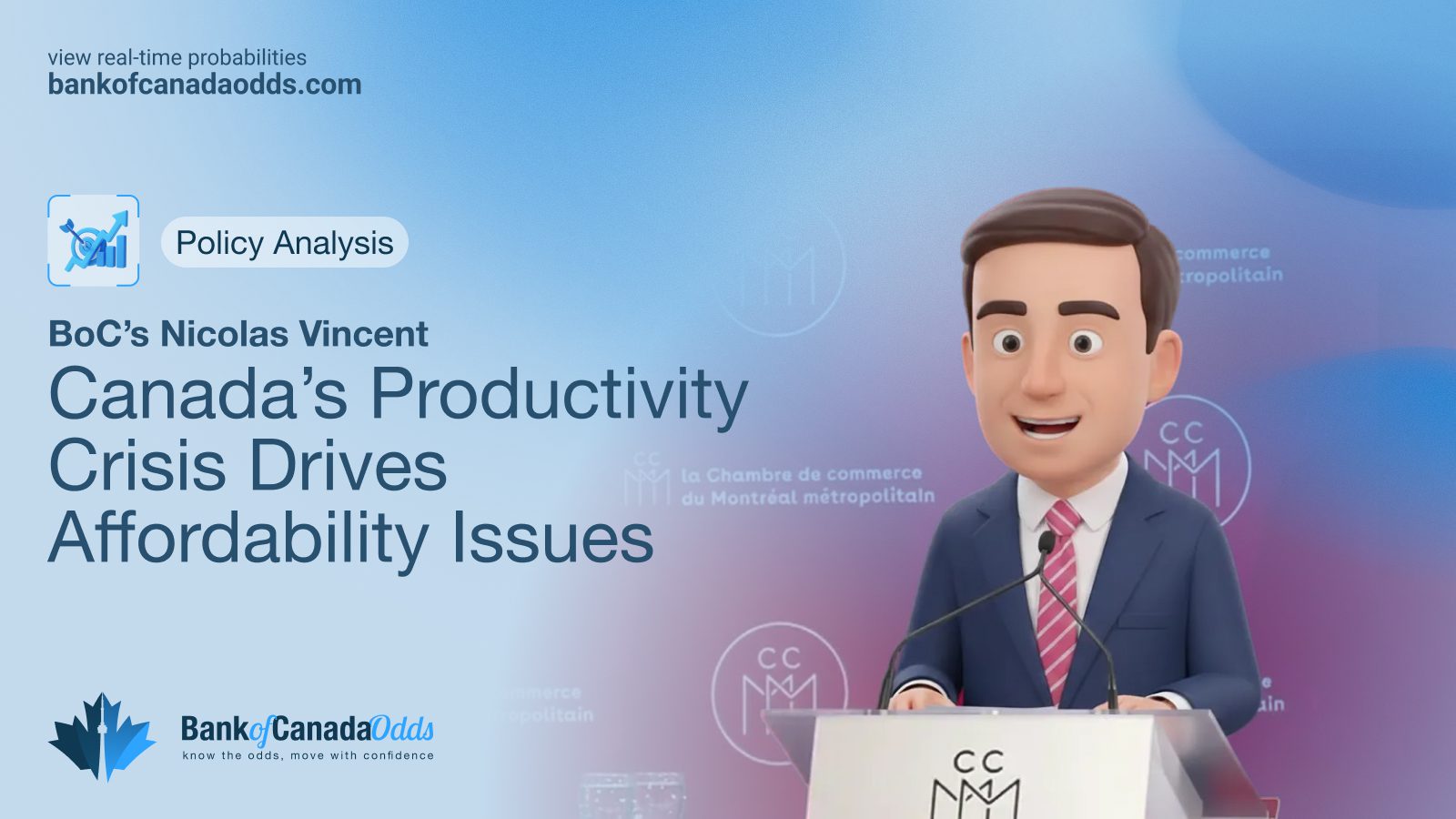
Canada’s affordability problem isn’t just about high prices. It is about Canada’s productivity crisis, according to Bank of Canada external deputy governor Nicolas Vincent. Speaking at an event in Quebec on Wednesday, Vincent warned that unless Canada raises its economic capacity, incomes will not keep pace with rising living costs. Consequently, affordability will continue to deteriorate even if inflation cools.
“Improving productivity is essential if we want Canadians to afford the goods, services and housing they need,” Vincent said. He emphasized that stronger wage growth depends entirely on stronger productivity growth.
Why Canada’s Productivity Crisis Matters for Households
Vincent argued that affordability issues run much deeper than inflation. The real problem is that Canadian earnings have stalled because business investment and innovation have failed to keep up with other advanced economies. In fact, Vincent estimated that if Canada had matched the productivity growth of other G7 nations since 2000, Canadian GDP would be roughly $5,000 to $7,000 higher per person today.
He highlighted several structural weaknesses that are keeping living standards from rising, which you can explore further in our analysis of The Six Drivers of the economy:
- Weak business investment
- Slow adoption of new technologies
- Limited competition in telecom, transportation, and financial services
- Skills mismatches and slow credential recognition across provinces
The result is a “vicious circle” where weak investment leads to low productivity, which suppresses wage growth. This leaves Canadians feeling poorer because their paycheques aren’t rising fast enough to offset persistent cost pressures.
BoC Says Fixing Productivity Is Key to Long-Term Affordability
At the Quebec event, Vincent called for policy reforms to reverse the slump. He noted that the central bank cannot solve Canada’s productivity crisis through monetary policy alone. Instead, fiscal and structural reforms will be critical.
His key recommendations included:
1. Boost Investment and Innovation
Canada needs a more competitive environment that encourages businesses to scale, adopt technology, and invest in capital areas where the country has lagged for over a decade. According to a recent report by Global News, this lack of investment is a primary driver of the current stagnation.
2. Increase Competition in Concentrated Industries
More competition in telecom, transportation, and financial services could raise efficiency, innovation, and consumer choice, Vincent said. Breaking down interprovincial trade barriers is also essential for creating a more dynamic market.
3. Improve Labour Mobility and Workforce Skills
Canada should streamline training pathways and credential transfers so workers can move more easily between provinces and sectors. This aligns with the Bank’s broader message that a flexible workforce is key to economic resilience.
For more details on the Bank’s official stance, you can read the summary of the speech on the Bank of Canada website.
Implications for Future Rate Decisions
While the Bank of Canada continues navigating inflation, Vincent’s message signals that productivity will shape Canada’s long-term affordability outlook. This will directly influence how quickly rate cuts can deliver real relief to households. You can track the probability of these rate changes on our Bank of Canada Odds Dashboard.
Markets will be watching how these structural challenges intersect with the BoC’s upcoming rate path. Policymakers must assess how much economic capacity has been lost during Canada’s slowdown. If you are unsure how these macroeconomic factors affect your finances, visit our How It Works page for a breakdown.
If you have questions about how Canada’s productivity crisis might impact mortgage rates or loan availability, feel free to contact us.