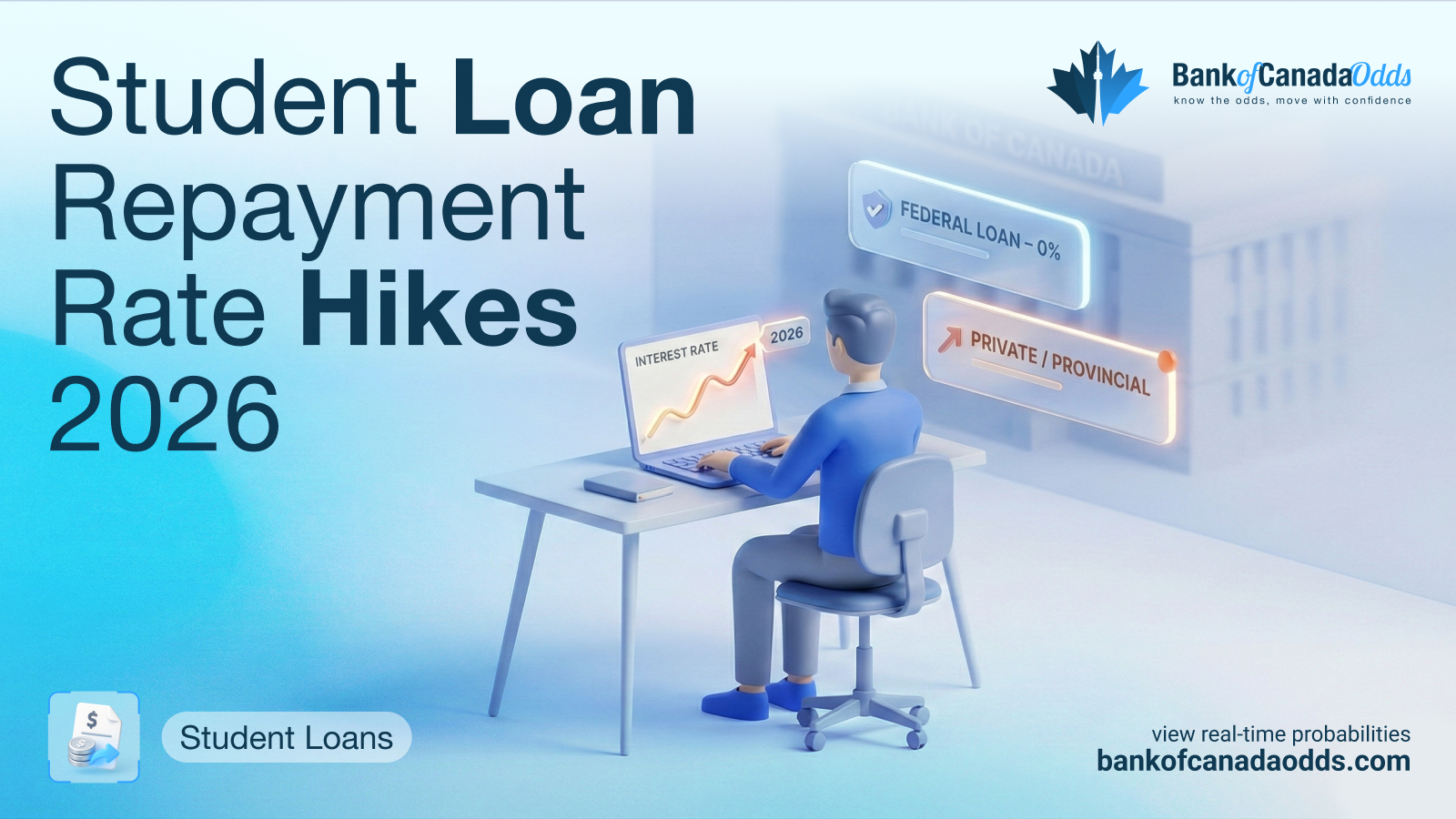
Federal student loans have been permanently interest-free since 2023 and therefore will never be impacted by Bank of Canada rate changes. However, provincial and private student loan repayment plans will continue to grow during periods when the Bank of Canada raises its policy rate.
Although the Bank of Canada has paused rates at 2.25% entering 2026, understanding how to manage debt during volatility is essential. This guide explains how Canadian borrowers can manage their student loan repayment during rate hikes, including strategies, budgeting techniques, and ways to reduce interest exposure. To stay informed on future rate moves, visit our Odds Dashboard.
Key Takeaways
- Federal student loans remain permanently interest-free and are not impacted by Bank of Canada rate hikes.
- Provincial (ON, AB, SK) and private student loans become more expensive when the BoC raises interest rates.
- High-interest and variable-rate student debt should be prioritized first.
- Refinancing, consolidation, and RAP can significantly reduce repayment pressure.
- Strong budgeting is essential to avoid missed payments during rising-rate periods.
What Are My Options for Student Loan Repayment?
There are several options available to make managing these additional interest charges easier during your student loan repayment journey.
Prioritize Your High-Interest Student Debt
As interest rates fluctuate, the importance of paying off your high-interest and variable-rate student debt grows. Once you have cleared the highest-interest debts (such as private lines of credit), you can then consider using one of the other methods below to reduce your overall student loan debt.
Use Targeted Payments
Using larger-than-usual payments to aggressively repay the principal portion of your outstanding debt can save you thousands of dollars in interest over the life of your loans. This is especially effective for the provincial portion of your loan in Alberta or Ontario.
Consolidation
Consolidating multiple loans into a single loan with a lower interest rate and/or lower monthly payment can also significantly reduce your interest payments over time. Learn more about how consolidation works in our How It Works section.
Refinance Your Student Loans
If you currently have a high-interest private student loan, you may want to consider refinancing your student loans at a lower interest rate to reduce the amount of money you spend each month on interest. Be aware, however, that while refinancing can help you save money on interest, you may lose eligibility for income-driven repayment plans such as RAP.
Apply for Income-Driven Repayment Plans
If you are experiencing financial hardship and are struggling to afford your monthly payments, you may qualify for an income-driven repayment plan (such as RAP). These plans base your monthly payment on your income rather than your original loan amount. Check the Repayment Assistance Plan (RAP) page for details. In 2026, single borrowers earning under approximately $40,000 may qualify for zero payments.
Create a Budget That Works For You
Regardless of what method you choose above, creating a budget that allows you to afford your monthly payments is essential. With a solid budget in place, you will be able to avoid making late payments and potentially damaging your credit score.
Manage Your Student Loan Repayment During Rising Interest Rates
Here is a step-by-step guide to managing your student loan repayment through fluctuating interest rates:
Step One: Prioritize Your High-Interest Student Debt
As interest rates rise, it becomes increasingly important to pay down your high-interest and variable-rate student debt now.
Step Two: Use Targeted Payments To Aggressively Repay Your Principal Balance
Using larger-than-usual payments to aggressively repay the principal balance of your outstanding debt can save you thousands of dollars in interest over the life of your loans.
Step Three: Consider Consolidating Multiple Loans Into a Single Loan
Consolidating multiple loans into a single loan with a lower interest rate and/or lower monthly payment can also significantly reduce your interest payments over time.
Step Four: Refinance Your Student Loans
If you currently have a high-interest private student loan, you may want to consider refinancing your student loans at a lower interest rate to reduce the amount of money you spend each month on interest. Be aware, however, that while refinancing can help you save money on interest, you may lose eligibility for income-driven repayment plans such as RAP.
Step Five: Apply For Income-Driven Repayment Plans
If you are experiencing financial hardship and are struggling to afford your monthly payments, you may qualify for an income-driven repayment plan (such as RAP). These plans base your monthly payment on your income rather than your original loan amount, so if you are earning less than expected, you will likely qualify for a lower payment.
Step Six: Create a Budget That Works For You
Regardless of what method you choose above, creating a budget that allows you to afford your monthly payments is essential. With a solid budget in place, you will be able to avoid making late payments and potentially damaging your credit score. For economic insights that can help with budgeting, visit The Six Drivers section.
Will My Student Loans Increase If the Bank of Canada Raises Rates?
While federal student loans have been permanently interest-free since April 1, 2023—and therefore are not affected by Bank of Canada rate changes—many other student loans, including private and variable-rate provincial loans, can become more expensive when the Bank of Canada raises its policy rate. Understanding how these rate changes impact different types of student debt is essential for effective student loan repayment planning.
Which Student Loans Will Be Affected By Rate Hikes?
Bank of Canada rate hikes directly affect private student loans (lines of credit) and variable-rate provincial loans in Alberta, Ontario, and Saskatchewan. Since federal student loans and provincial loans in BC, MB, NB, NL, NS, and PEI are interest-free, they will not be impacted by Bank of Canada rate hikes. You can verify current rates on the Bank of Canada website.
Is It Smart To Refinance Your Student Loans During Rising Interest Rates?
Refinancing your student loans at a lower interest rate can help you save money on interest and make it easier to manage your monthly payments. Therefore, yes—refinancing your student loans during periods of high interest rates is a great option, provided you can secure a lower fixed rate.
Should I Pay Off My Federal Student Loans Early?
Since federal student loans are interest-free, there is no financial reason to pay them back before they are due. It is mathematically better to allocate extra funds to high-interest private debt or savings.
Does RAP Help During Rate Hikes?
Yes—RAP can provide relief during times of increasing interest rates. In addition to reducing the amount of money you owe per month, RAP can also provide interest support for eligible borrowers, ensuring your balance does not grow even if rates spike.
Frequently Asked Questions (FAQ)
For more answers, check our Main FAQ page.
Do federal student loan payments increase during Bank of Canada rate hikes?
No. Federal student loans are permanently interest-free and never change with BoC decisions.
Which student loans are affected when the Bank of Canada raises rates?
Private student loans and variable-rate provincial loans (specifically in Ontario, Alberta, and Saskatchewan). These will become more expensive as the BoC raises its lending rates.
Is refinancing a good idea during rising interest rates?
Yes—if you can secure a lower fixed rate. Refinancing can reduce interest costs but may remove access to programs like RAP.
Should I prioritize paying off federal student loans?
No. Since federal student loans are interest-free, pay them last. Focus first on high-interest or variable-rate loans.
Does RAP help during rising interest rates?
Yes. RAP can reduce monthly payments and offer interest support for eligible provincial borrowers during periods of financial strain.
Conclusion
Managing student loan repayment during rising interest rates requires strategic planning, targeted repayment, and awareness of how rate changes affect different types of debt. By prioritizing high-interest loans, considering consolidation or refinancing, and using repayment assistance programs, borrowers can protect themselves financially even as rates climb. Stay updated on rate changes by joining our Subscription list.